Apartamento

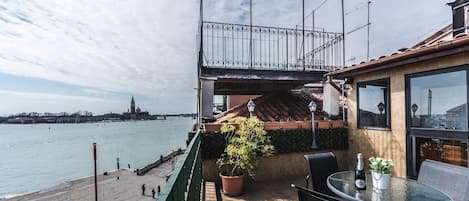
Amazing, terrace great view and sunny in Castello authentic venetian area

Galeria de fotos de Amazing, terrace great view and sunny in Castello authentic venetian area

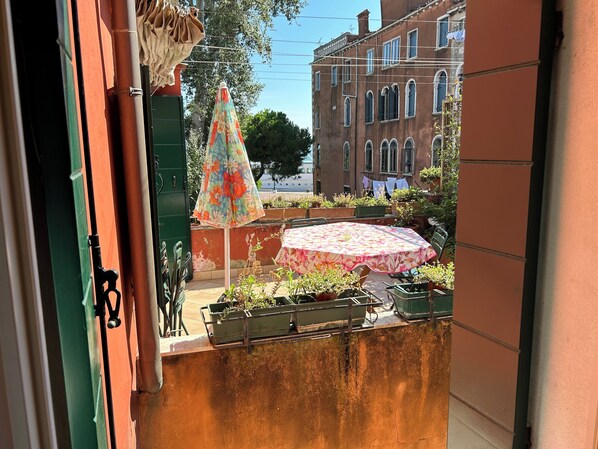
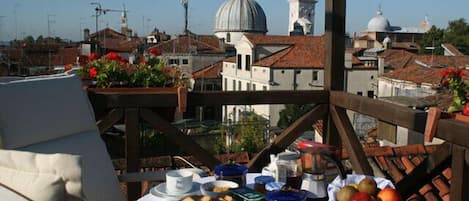
Varanda com mesa coberta por toalha florida, plantas em vasos e um guarda-sol colorido.
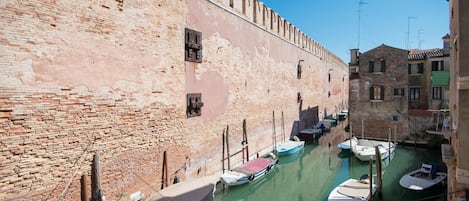
Um bairro residencial com edifícios altos, um caminho e árvores.
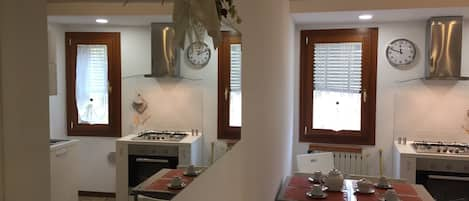
Uma sala de jantar com uma mesa posta para chá, uma janela com vista para edifícios e uma porta que dá para o exterior.
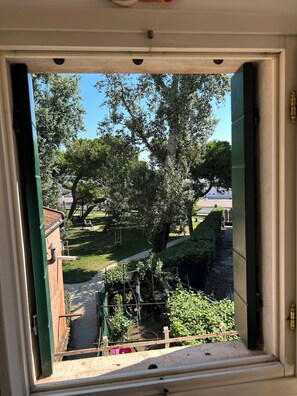
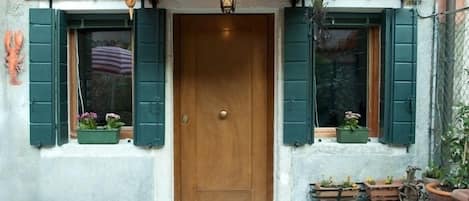
Vista pela janela, com moldura verde, mostrando um jardim com caminho, árvores e cerca.
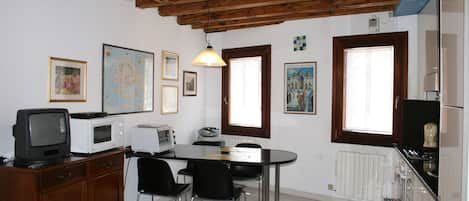
Uma sala de estar com um sofá verde, uma mesa de centro de vidro, uma luminária, uma TV e vigas de madeira no teto.

Avaliações

9,8 de 10, Hóspedes adoram
Entre as melhores avaliações de hóspedes nesta área

Destaques

  • Vista para a água de encher os olhos

    Relaxe e desconecte-se do mundo nesta propriedade com boas avaliações pela vista para a água.
  • Localização central

    Localização conveniente para que você nunca fique longe de onde precisa estar.
  • Descubra os pontos de referência nos arredores

    Nos arredores de Piazza San Marco
1 quarto2 banheirosAcomoda 4 pessoas

Comodidades populares

  • Banheira de hidromassagem no local
  • Estacionamento no local disponível
  • Cozinha
  • Lava-roupa
  • Ar-condicionado
  • Deque ou pátio

Explore a região

Confira no mapa
Venezia, Veneto
  • Place, Via Garibaldi
    ‪1 min de caminhada‬
  • Place, Arsenale di Venezia
    ‪2 min de caminhada‬
  • Place, Arsenal da Bienal de Veneza
    ‪2 min de caminhada‬

Quartos e camas

1 quarto (acomoda 4 pessoas)

Quarto 1

1 cama de solteiro e 1 cama Queen

Quarto 2

1 futon casal

2 banheiros

Banheiro 1

Banheira · Bidê · Vaso sanitário

Banheiro 2

Bidê · Vaso sanitário · Apenas chuveiro

Espaços

Deque ou pátio
Cozinha
Espaço para refeições

Sobre esta propriedade

Amazing, terrace great view and sunny in Castello authentic venetian area

Wonderful apartment of 70 m2 with terrace in Castello with view, can accommodate up to 5 people. This apartment has living room, bedroom, kitchen, terrace, 2 bathrooms. A double sofa bed (130 cm) a double bed and a single in the bedroom

We also offer Rome and France!

The studio is located in the Sestiere de Castello. The largest of Venice's sestiere, located east of San Marco and Cannaregio, it stretches to the Arsenal, the Giardini and beyond.

Away from the hectic life of the Saint Marco sestiere, Castello is gradually transforming into a charming residential area of sleeping campi above which floats the linen hanging on the windows, shops with local customers, leading a peaceful life in the amidst its tranquil canals ..

To see in Castello:

• The Church of Santi Giovanni e Paolo (Zanipolo)
• The Arsenal
• The Naval Museum (Museo Storico Navale di Venezia)
• The Fondazione Querini Stampalia museum
• The museum of the Grimani Palace
• La Scuola di San Giorgio degli Schiavoni (paintings by Carpaccio)
• The Museo di Dipinti Sacri Byzanti (Collection of Byzantine icons)
• La Pieta church (frequented by Vivaldi)
• The Biennial Pavilions
• La Donna Partigiana, on the Riva Dei Partigiana, Giardini - a moving monument erected in memory of the women killed during the Second World War; the bronze statue of a reclining woman is submerged and only appears at low tide.

Brief history of Venice. The keys to Venice's economic domination of Italy in the Middle Ages were the insularity and naval ease of the Venetians, which had grown steadily for more than a millennium.
The region at the north-west end of the Adriatic Sea, where several rivers from the Alps flow, has been inhabited since Antiquity by fishermen, sailors and salt workers. This area was part of region X created by Auguste. This region was then named Venetia after the Venetians, an ancient Italic people integrated into the Roman Republic from the 2nd century BC. J-C; Aquileia - on dry land - was the important religious and port center.
The Gothic invasions of Alaric I and the Huns of Attila prompted local populations to take refuge in the marsh islands along the Adriatic Sea, near the Po Delta. According to the legend developed later by the Venetians to demonstrate the antiquity of their city and the distant origin of their freedom, Venice would have been founded on March 25, 421 in the islets of the rivus altus, which will become the Rialto.

In 452, a first establishment was founded by refugees from Padua and Aquileia. The region later fell into the Ostrogothic kingdom and was then reconquered with the rest of Italy by General Bélisaire, becoming a province of the Eastern Roman Empire under Justinian I.
The city of Venice was founded towards the end of the sixth century by inhabitants of neighboring regions, who came to take refuge in large numbers in the islands of the lagoon formed by the Po estuary after the invasion of northern Italy by the Lombards in 568. Indeed, this marshy area, difficult to access for keel vessels, had remained under the jurisdiction of the exarchate of Ravenna, province of the Eastern Roman Empire. It was therefore initially a refuge for Roman-Byzantine civilization, but as it developed, its autonomy increased to lead to independence.

Taking advantage of the antagonism between the Ravenna exarchate and the Lombards, the Venetians widened their political leeway and acquired local power embodied by the first duke or "doge", Paolucio Anafesto (697-717), character at the edge of legend and history. The city of Venice did not really become independent until after the withdrawal of the Byzantines from the Adriatic, shortly after the year 1000, when the kingdom of Hungary emerged. The city-state therefore relied on the sea to extend its power.

Venice did not have its own constitution. In fact, the definition of powers and the mechanism of government institutions came under customary law in Venice. The governmental decision-making bodies formed a pyramid of which the People's Assembly was the base and the Doge the summit. Between the two sat the Grand Council, the Forty and the Senate, then the Ducal Council. This political organization, the features of which emerged in the 13th century, continued until 17974. The quadrupling of naval power in the first third of the 15th century made the Arsenal of Venice the largest factory in the world, employing up to 16,000 people, behind a 25-hectare secret enclosure. Naval activity is driven by the dynamism of the Venetian business district.

The salt trade, then the commercial expansion towards the Eastern Mediterranean, led to a strong growth of the city. After the 4th crusade, which Venice diverted to Constantinople, the Republic seized the riches of the Byzantine Empire and constituted its own maritime empire made up of most of the Greek and Dalmatian islands. It completes it by conquering continental Dalmatia, Istria and a vast area between the Alps and the Po, including the cities of Bergamo, Brescia, Verona, Padua, Treviso and Udine. It comes into conflict with Genoa, its great rival in northern Italy and the Mediterranean. The climax of this struggle will be the Fourth Genoese War, otherwise known as the Chioggia War. Venice emerged victorious from the conflict, but very exhausted. The Treaty of Turin, in 1381, was not particularly advantageous to him: in spite of its victory, Venice had to give up territories and concede certain rights to its rival. She lost Treviso and Dalmatia which returned to the king of Hungary. However, it retained its institutions and its main colonies.

The city has armed a fleet of 6,000 galleys, allowing it to take risks, in the form of regular convoys, to reign over the Mediterranean Sea. The Rialto district is the first organized exchange, according to historian Fernand Braudel. The merchants there exchanged stakes in the Venetian galleys, auctioned according to the Incanto system of market galleys5. Venice thus becomes the most important port in the Mediterranean, surpassing Constantinople. He had to conquer land on the lagoon.
The decline began with Turkish progression in the Mediterranean, which gradually deprived it of all its Greek lands, with the exception of the Ionian Islands, and of its access to the outlets of the Silk Road, which was moreover very affected by the plague. black. Despite the victory over the Turks at Lepanto in 1571, the republic of Venice still lost its commercial importance due to the diversion of European trade to the oceans after the discovery of America.
Venice maintains its cultural influence, becoming the most elegant and refined European city of the 18th century, with a strong influence on art, architecture and literature.
Become politically an Italian state among others, Venice was annexed by Napoleon Bonaparte on May 12, 1797, during the first coalition. The invasion of the French put an end to nearly 800 years of independence. Napoleon was however perceived as a sort of liberator by the poor and Jewish population of Venice, an aristocratic republic where power and most of the wealth were monopolized by a few families. Napoleon removed the Ghetto barriers as well as the movement restrictions imposed on the Jews.

In 1797, by the Treaty of Campo-Formio, Napoleon delivered Venice and its territories to the Habsburgs in exchange for Belgium, then he took it back in 1805 to integrate it into the kingdom of Italy of which he was crowned king, before the city was not integrated into the Austrian Empire from 1815 to 1866. Austrian domination of Venice and the Veneto did not end until October 3, 1866 after its defeat of Sadowa against the Prusso-Italian alliance. Venice became an Italian provincial capital and one of the high places of world tourism.

After the First World War, Italy claimed the defeated whole of Venetian territories from Austria, but came up against Yugoslav claims and only obtained Istria, the city of Zara in Dalmatia, and the Treaty of Rapallo. islands of Veglia, Cherso and Lagosta. The resentment developed at that time contributed to Mussolini's later success. After the Second World War, Italy also lost these possessions to the benefit of Yugoslavia, keeping only Trieste which is not part of the former Venetian territories, but where the Italian-speaking populations expelled from Yugoslavia took refuge.

When you arrive at the apartment we will ask you for the cash payment of the "Tassa di Soggiorno" that the Municipality of Venice has recently established for private apartments for rent (currently 1.5 euros / person / night). You will receive a receipt for this payment.

Adicione as datas e descubra os preços

Propriedades semelhantes

Regras da propriedade

Check-in após 15h

Check-out até 10h

default

Crianças

Aceita hóspedes de 0 a 17 anos

default

Eventos

Não permite a realização de eventos

default

Animais de estimação

Não aceita animais de estimação

default

Política para fumantes

Não é permitido fumar

Instruções para o check-out

A pessoa anfitriã requer que você realize estas tarefas antes do check-out:

Remover itens pessoais, remover restos de comida e bebida e tirar o lixo

Apagar as luzes

Caso você não cumpra essas instruções, pode receber uma avaliação negativa do anfitrião.

Informações importantes

O que você precisa saber

Número de registro da propriedade IT027042B44QVNEAP4
Propriedade nº 1366179a
Pessoas extras podem incorrer em taxas adicionais que variam dependendo da política da propriedade.
Documento de identificação oficial com foto e cartão de crédito, cartão de débito ou depósito em dinheiro podem ser exigidos no momento do check-in para despesas extras.
Solicitações especiais estão sujeitas à disponibilidade no momento do check-in e podem incorrer em taxas adicionais. Essas solicitações não estão garantidas.
Esta propriedade aceita dinheiro.
Festas ou eventos de grupos no local são estritamente proibidos
O anfitrião informou que a propriedade tem detector de monóxido de carbono.
O anfitrião informou que a propriedade tem detector de fumaça.
Esta propriedade tem espaços externos, como sacadas, pátios ou terraços, que podem não ser adequados para crianças; se tiver alguma preocupação, recomendamos entrar em contato com a propriedade antes da chegada para confirmar se é possível acomodar você em um quarto adequado

Informações a área

Veneza

Na orla marítima em Veneza, este apartamento fica no bairro Castello. Porto de Veneza e Terminal Fusina são atrações ideais para quem procura aventuras. Para conhecer as belezas naturais da região, explore lugares como Praias do Lido di Venezia e Marina de Veneza. Estação marítima e Zattere também valem a visita. Mergulho autônomo e pesca são ótimas oportunidades para se refrescar, mas você também pode tentar atividades como trilhas para caminhada/bicicleta e passeios a cavalo nos arredores.
Mapa
Venezia, Veneto

Nos arredores

  • Via Garibaldi - 1 min de caminhada - 0.0 km
  • Arsenale di Venezia - 2 min de caminhada - 0.2 km
  • Arsenal da Bienal de Veneza - 2 min de caminhada - 0.2 km
  • Giardini della Biennale - 8 min de caminhada - 0.7 km
  • Bienal de Veneza - 8 min de caminhada - 0.7 km

Restaurantes

  • ‪Gelateria Bucintoro Ristorante - ‬7 min de caminhada
  • ‪Al Covo - ‬7 min de caminhada
  • ‪Caffè La Serra - ‬6 min de caminhada
  • ‪La Nuova Perla - ‬2 min de caminhada
  • ‪Bacarando ai Corazzieri - ‬9 min de caminhada

Perguntas frequentes

Amazing, terrace great view and sunny in Castello authentic venetian area é ideal para quem viaja com animais de estimação?

Não, animais de estimação não são permitidos nesta propriedade.

Quanto custa o estacionamento em Amazing, terrace great view and sunny in Castello authentic venetian area?

Estacionamento no local disponível na propriedade.

Qual é o horário de check-in em Amazing, terrace great view and sunny in Castello authentic venetian area?

Horário de início do check-in: 15h.

Qual é o horário de check-out em Amazing, terrace great view and sunny in Castello authentic venetian area?

Horário de check-out: 10h.

Onde fica Amazing, terrace great view and sunny in Castello authentic venetian area?

Em Castello, este apartamento fica a 15 minutos a pé de Via Garibaldi, Piazza San Marco e Palazzo Ducale. Grand Canal e Ponte dei Sospiri também ficam a 2 km.

Sobre o anfitrião

Anfitrião: Marc et Elisabeth Regnault de la Mothe

Imagem do perfil do anfitrião

Idiomas:

Inglês, Francês, Italiano, Espanhol, Português

Anfitrião Premium

Essas pessoas oferecem, de maneira consistente, ótimas experiências aos viajantes.

Como podemos melhorar nosso site?Compartilhar opinião