
Guardar
Casa completa
CORTE DEI GRECI - Best and rest in Salento, on the border between sea and countryside
Galería de fotos de CORTE DEI GRECI - Best and rest in Salento, on the border between sea and countryside
4 habitaciones4 baños13 personas
Servicios principales
- Alberca
- Cocina
- Lavadora
- Wifi gratuito
- Aire acondicionado
- Espacio al aire libre
Explora la zona

Campomarino, Puglia
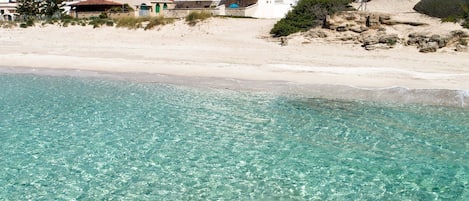
- Dunas de CampomarinoPlace, Dunas de Campomarino7 min a pie
- Puerto de CampomarinoPlace, Puerto de Campomarino10 min a pie
- Playa de AyalaPlace, Playa de Ayala12 min a pie
Habitaciones y camas
4 habitaciones (para 13 personas)
Habitación 1
1 cama Queen y 1 cama individual
Habitación 2
1 cama individual y 1 cama Queen
Habitación 3
1 cama individual y 1 cama Queen
Habitación 4
1 litera King y 1 cama King
4 baños
Baño 1
Baño 2
Baño 3
Baño 4
Ambientes
Deck o patio
Cobertizo o lanai
Cocina
Con balcón
Jardín
Información de la propiedad
CORTE DEI GRECI - Best and rest in Salento, on the border between sea and countryside
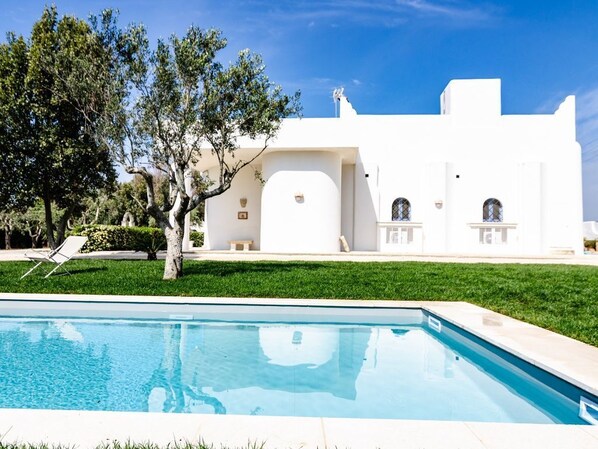
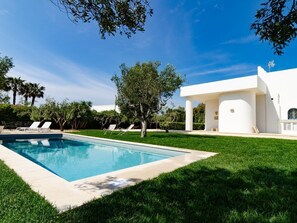
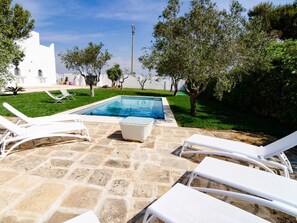
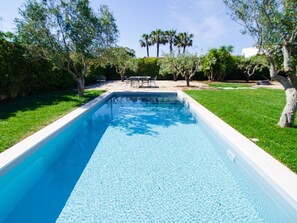
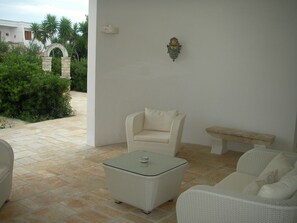
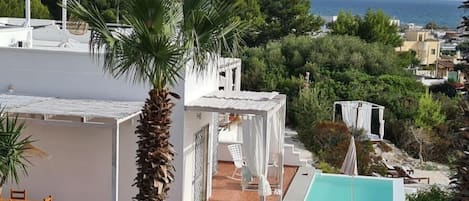
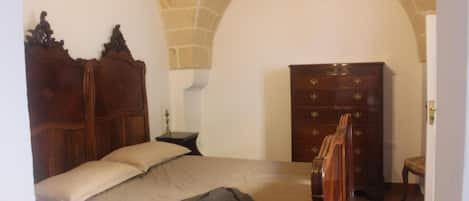
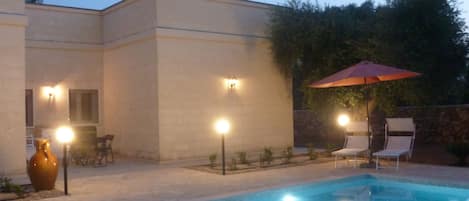
Ideal solution for three to four families. This is an elegant residence for summer holidays with swimming pool, located 300 meters as the crow flies from the beach in Campomarino, a seaside resort in the Ionian Sea, in the historic bay of the Gulf of Taranto, near the homonymous city that was a Spartan colony and capital of Magna Grecia, very suitable for families with children and young people, groups of families. The body of the building entirely preserved and perfectly reconditioned, dates back to the mid-nineteenth century, and is made in the typical Salento style, with high vaults entirely in masonry, in the classic type "sail and eight-pointed star", white plasters, external stone walking surface, and wooden wisteria windows. Finishes and architectural elements common also to Hellenic island and peninsular locations. In the seventies, on the south side of the building, a large veranda was built and annexed to the original building, where guests can entertain themselves also appreciating a certain privacy guaranteed by the large surface of the patio. The building falls in a courtyard area planted with olive trees, agaves and pythosphorus, covering approximately 2,300 square meters, entirely protected by a fence. Guests can access the interior of the aforementioned area, by car via a remote controlled sliding gate (there is another gate with manual opening). From the living room entrance, you can access each of the four bedrooms, which have an independent and separate entrance. Each bedroom, is furnished in a sober but complete way, and embellished with majolica elements of Grottaglie and Vietri, is windowed with mosquito nets, as well as equipped with air conditioning, TV, private bathroom with window and complete with bidet, cup, sink, large shower cubicle, hairdryer, terry towels, floor and mosaic finishes. From the living room also equipped with air conditioning, you can access the kitchen compartment; also, outdoor barbecue. In the kitchen there is a large 560-liter refrigerator with its freezer, various pots, cutlery, plates, glasses, accessories and other appliances. THE STRUCTURE HAS COMPLETELY DEBACTERIZED WATER, BUT IN THE CASE OF "HARD" WATER, IT HAS A CHEMICAL COMPOSITION SUCH AS IT IS NOT SUITABLE FOR DRINKING. IT IS OK FOR ALL OTHER USES. Triple rooms ARTEMIS, NIKE AND POSEIDON double rooms + extra bed with bathroom, tele clima. Quadruple room: ZEUS, with bathroom, climate, canvas, having a larger surface. It is equipped with a double bed and a bunk bed for adults. Ability to comfortably place fifth bed.
Visit:
MANDURIA
The town, located in northern Salento, is equidistant from Taranto, Lecce and Brindisi. it is also known as 'City of Messapi' and of 'Primitivo'. Founded by the Messapi around the 10th century BC. C, defended by the attacks of the Tarantino / Spartan militias in 472 a. C. (Herodotus - Stories), and a second time from those led by the king of Sparta Archidamo who perished in front of the walls, perished in 338 a. C. (Plutarch, Parallel Lives), and subsequently destroyed by Quinto Fabio Massimo during the second Punic war (quoted in Ab Urbe Condita - Tito Livio), still bears numerous testimonies of its ancient past, including the megalithic walls (5th-2nd century . a. C.), built on the moat that surrounded the city and the necropolis (VII century BC). An important monument from the Messapian era is the Fonte Pliniano (registered in Naturalis Historia - Pliny the Elder). Among the main monument area are the Romanesque collegiate church (better known as the Mother Church), the Jewish ghetto of the medieval era , the clock tower, palaces with a noble appearance built in various eras and features of the ancient Messapian circle of walls. Particular interest arouses the visit to the local wineries where it is possible to appreciate the famous 'Primitivo' of Manduria. HIST. Located in a hilly area in the northern Salento on the border with the Murgia, it was an important Messapian and later Roman center, the city is known in the Middle Ages for its Jewish community. Not far from the route of the ancient Via Appia between Brindisi and Taranto, Oria is 35 km from Taranto, 32 km from Brindisi and 45 km from Lecce. Monuments and places of interest: Frantoio Ipogeo The Oria oil mill or hypogeum trappeto represents the last traces of the flourishing rural civilization of the 14th century. Castle of Oria: it was a welcoming place for kings, princes and knights; in addition to the guests at the wedding of Frederick II, we remember that Queen Maria d'Enghien (1407), her husband Ladislao king of Naples (1414), princess Isabella of Chiaromonte and king Ferrante of Aragon (1447) stayed there; the Castle of Oria, declared a National Monument, was sold on July 2, 2007 to Borgo Ducale srl. Door of the Jews. Also known as Porta Taranto because from here we headed towards the Ionian city, it is one of the 3 city gates (one of which is no longer in situ). The door, which leads to the Giudecca of the Jewish community of Oria, gives access to a tortuous medieval quarter, with small houses, shops, hidden balconies. The Tournament of the Wards it originates from the announcement that Emperor Frederick II wanted to issue in 1225, during a period of stay in Oria. Athletes and riders belonging to the four districts challenge each other in the tough medieval tests valid for the assignment of the coveted 'Palio'. A wonderful show of colors and sensations that makes use of the high patronage of the Presidency of the Republic and which for some years has been combined with one of the national lotteries, thanks also to the twinning with the Federician cities of Jesi and Palermo. An appointment not to be missed that is repeated every year - since 1967, in the second weekend of August - to relive one of the most fascinating and mysterious pages of Apulian history. GROTTAGLIE Rich in history and natural beauty, about 25 km away, the town of Grottaglie (from the Latin Kriptalys, a name that emphasizes the presence of caves in much of its territory) with the many sports, cultural and voluntary structures present in the area , is one of the most active centers in the Province of Taranto, but is famous all over the world especially for its majolica. Forte is, in fact, also the tourist attraction exercised by the Ceramiche district itself. The ceramic craftsmanship is of particular importance in the city, so much so that there is also an art institute that trains students in this process. Among the peculiarities of the Grottagliese ceramics are some objects including: lu capasone (large container that serves to store and keep wine or oil in good condition), the chat with lid (blanched jug that originally had in the eighteenth century a ornamental function), lu srulu, a sort of ceramic jug inside which wine was used to put water, and its variant 'lu srulu a secret', 'lu pumu' (pumo), a terracotta object that places at the corners of the balconies of the Ionian town: this object, shaped like a bud, often appears as an ornament at the corners of the balconies of the houses in the historic city center. Of great notoriety and collectible interest are the Grottagliese ceramics of the 19th and 18th centuries. Noteworthy is the Ceramics Quarter, located south of the historic center, has been the main place of residence and work for small ceramic artisans since the 18th century, and today there are still some small artisan and manufacturing activities dedicated to working with ceramics. MARUGGIO. The town was founded between 870 and 963 in a hidden position within a natural depression to not be very visible from the sea and therefore to defend itself against Saracen attacks. Maruggio was first a fief of the Cateniano family and later, starting from 1130, the year in which Roger II unified the duchy of Puglia to that of Calabria giving life to the Kingdom of Sicily, it was in the possession of the De Marresio (or Marrese). A long period of wealth and tranquility for the town began with the 16th century. In the sixteenth century Maruggio was elevated by the Knights of Malta to a masterful command. They ruled it continuously from 1317 to 1819, when the commandery finally disappeared, after having already been suppressed on August 2, 1806.
Visit:
MANDURIA
The town, located in northern Salento, is equidistant from Taranto, Lecce and Brindisi. it is also known as 'City of Messapi' and of 'Primitivo'. Founded by the Messapi around the 10th century BC. C, defended by the attacks of the Tarantino / Spartan militias in 472 a. C. (Herodotus - Stories), and a second time from those led by the king of Sparta Archidamo who perished in front of the walls, perished in 338 a. C. (Plutarch, Parallel Lives), and subsequently destroyed by Quinto Fabio Massimo during the second Punic war (quoted in Ab Urbe Condita - Tito Livio), still bears numerous testimonies of its ancient past, including the megalithic walls (5th-2nd century . a. C.), built on the moat that surrounded the city and the necropolis (VII century BC). An important monument from the Messapian era is the Fonte Pliniano (registered in Naturalis Historia - Pliny the Elder). Among the main monument area are the Romanesque collegiate church (better known as the Mother Church), the Jewish ghetto of the medieval era , the clock tower, palaces with a noble appearance built in various eras and features of the ancient Messapian circle of walls. Particular interest arouses the visit to the local wineries where it is possible to appreciate the famous 'Primitivo' of Manduria. HIST. Located in a hilly area in the northern Salento on the border with the Murgia, it was an important Messapian and later Roman center, the city is known in the Middle Ages for its Jewish community. Not far from the route of the ancient Via Appia between Brindisi and Taranto, Oria is 35 km from Taranto, 32 km from Brindisi and 45 km from Lecce. Monuments and places of interest: Frantoio Ipogeo The Oria oil mill or hypogeum trappeto represents the last traces of the flourishing rural civilization of the 14th century. Castle of Oria: it was a welcoming place for kings, princes and knights; in addition to the guests at the wedding of Frederick II, we remember that Queen Maria d'Enghien (1407), her husband Ladislao king of Naples (1414), princess Isabella of Chiaromonte and king Ferrante of Aragon (1447) stayed there; the Castle of Oria, declared a National Monument, was sold on July 2, 2007 to Borgo Ducale srl. Door of the Jews. Also known as Porta Taranto because from here we headed towards the Ionian city, it is one of the 3 city gates (one of which is no longer in situ). The door, which leads to the Giudecca of the Jewish community of Oria, gives access to a tortuous medieval quarter, with small houses, shops, hidden balconies. The Tournament of the Wards it originates from the announcement that Emperor Frederick II wanted to issue in 1225, during a period of stay in Oria. Athletes and riders belonging to the four districts challenge each other in the tough medieval tests valid for the assignment of the coveted 'Palio'. A wonderful show of colors and sensations that makes use of the high patronage of the Presidency of the Republic and which for some years has been combined with one of the national lotteries, thanks also to the twinning with the Federician cities of Jesi and Palermo. An appointment not to be missed that is repeated every year - since 1967, in the second weekend of August - to relive one of the most fascinating and mysterious pages of Apulian history. GROTTAGLIE Rich in history and natural beauty, about 25 km away, the town of Grottaglie (from the Latin Kriptalys, a name that emphasizes the presence of caves in much of its territory) with the many sports, cultural and voluntary structures present in the area , is one of the most active centers in the Province of Taranto, but is famous all over the world especially for its majolica. Forte is, in fact, also the tourist attraction exercised by the Ceramiche district itself. The ceramic craftsmanship is of particular importance in the city, so much so that there is also an art institute that trains students in this process. Among the peculiarities of the Grottagliese ceramics are some objects including: lu capasone (large container that serves to store and keep wine or oil in good condition), the chat with lid (blanched jug that originally had in the eighteenth century a ornamental function), lu srulu, a sort of ceramic jug inside which wine was used to put water, and its variant 'lu srulu a secret', 'lu pumu' (pumo), a terracotta object that places at the corners of the balconies of the Ionian town: this object, shaped like a bud, often appears as an ornament at the corners of the balconies of the houses in the historic city center. Of great notoriety and collectible interest are the Grottagliese ceramics of the 19th and 18th centuries. Noteworthy is the Ceramics Quarter, located south of the historic center, has been the main place of residence and work for small ceramic artisans since the 18th century, and today there are still some small artisan and manufacturing activities dedicated to working with ceramics. MARUGGIO. The town was founded between 870 and 963 in a hidden position within a natural depression to not be very visible from the sea and therefore to defend itself against Saracen attacks. Maruggio was first a fief of the Cateniano family and later, starting from 1130, the year in which Roger II unified the duchy of Puglia to that of Calabria giving life to the Kingdom of Sicily, it was in the possession of the De Marresio (or Marrese). A long period of wealth and tranquility for the town began with the 16th century. In the sixteenth century Maruggio was elevated by the Knights of Malta to a masterful command. They ruled it continuously from 1317 to 1819, when the commandery finally disappeared, after having already been suppressed on August 2, 1806.
Agrega fechas para ver los precios
Propiedades similares

Lizzano: House / Villa - Taranto
Taranto
Lizzano: House / Villa - Taranto
Taranto
- Vista al mar
- Cocina
- Lavadora
- Acepta mascotas
10.0 de 10, Excepcional, (6 opiniones)
10/10
Excepcional
(6 opiniones)
Independent villa with sea view
Leporano
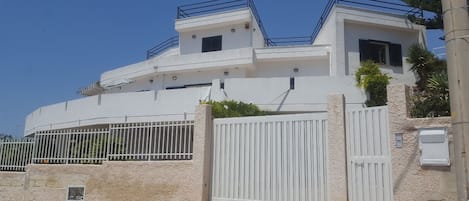
Independent villa with sea view
Leporano
- Vista al mar
- Alberca
- Cocina
- Lavadora

A modern villa set between Sava and Campomarino in a peaceful private setting.
Sava
A modern villa set between Sava and Campomarino in a peaceful private setting.
Sava
- Alberca
- Cocina
- Lavadora
- Acepta mascotas
9.8 de 10, Excepcional, (6 opiniones)
9.8/10
Excepcional
(6 opiniones)
Villa Esclusiva, Piscina Privata, Grande Giardino, Kid-area
Sava
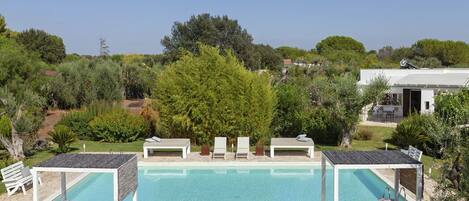
Villa Esclusiva, Piscina Privata, Grande Giardino, Kid-area
Sava
- Alberca
- Cocina
- Lavadora
- Acepta mascotas

Le Carrube Bed and Breakfast with Wi-Fi and Air Conditioning
Sava
Le Carrube Bed and Breakfast with Wi-Fi and Air Conditioning
Sava
- Alberca
- Aire acondicionado
- Desayuno disponible
- Estacionamiento disponible

Villa Medici Oria
Oria
Villa Medici Oria
Oria
- Alberca
- Cocina
- Lavadora
- Secadora

Ginepro - Shelter by the sea in Apulia | A few steps from the beach
Puglia
Ginepro - Shelter by the sea in Apulia | A few steps from the beach
Puglia
- Lavadora
- Secadora
- Aire acondicionado
Villa Stella Blu by BarbarHouse
San Pietro in Bevagna
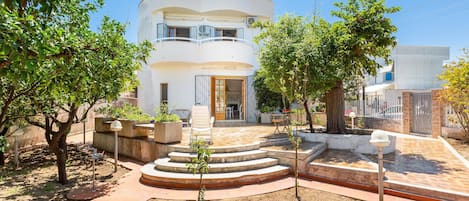
Villa Stella Blu by BarbarHouse
San Pietro in Bevagna
- Cocina
- Lavadora
- Acepta mascotas
- Aire acondicionado
8.0 de 10, Muy bueno, (1 opinión)
8.0/10
Muy bueno
(1 opinión)

Villa Lù in Salento
Campomarino
Villa Lù in Salento
Campomarino
- Lavadora
- Aire acondicionado
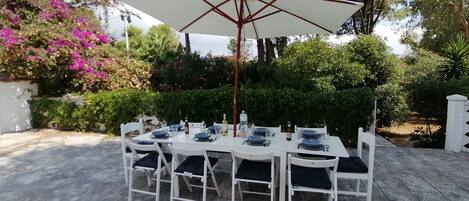
Seaside villa with garden in Salento
torre ovo torricella taranto
Seaside villa with garden in Salento
torre ovo torricella taranto
- Cocina
- Lavadora
- Acepta mascotas
- Aire acondicionado
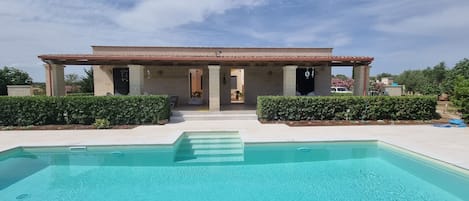
VILLA AMICORUM WEST and EAST, pool 10 x 4 m
San Pietro in Bevagna, Apulien
VILLA AMICORUM WEST and EAST, pool 10 x 4 m
San Pietro in Bevagna, Apulien
- Alberca
- Cocina
- Lavadora
- Acepta mascotas
10.0 de 10, Excepcional, (1 opinión)
10/10
Excepcional
(1 opinión)
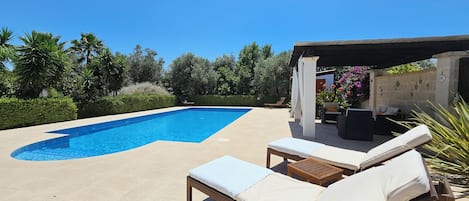
Delightful villa with private pool in landscaped gardens.
Oria
Delightful villa with private pool in landscaped gardens.
Oria
- Alberca
- Cocina
- Lavadora
- Secadora
10.0 de 10, Excepcional, (50 opiniones)
10/10
Excepcional
(50 opiniones)
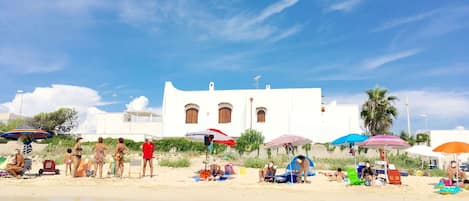
Villa directly on the beach with sea view (TL43)
Torre Lapillo
Villa directly on the beach with sea view (TL43)
Torre Lapillo
- Cocina
- Lavadora
- Acepta mascotas
- Aire acondicionado
9.0 de 10, Magnífico, (2 opiniones)
9.0/10
Magnífico
(2 opiniones)

Villa Auruca` by BarbarHouse
Campomarino
Villa Auruca` by BarbarHouse
Campomarino
- Cocina
- Lavadora
- Acepta mascotas
- Aire acondicionado

Sunset Torre Ovo by BarbarHouse
Torricella
Sunset Torre Ovo by BarbarHouse
Torricella
- Cocina
- Lavadora
- Aire acondicionado
- Vista a la playa
Villa Alba - infinity pool and roof top terrace
Marina di Lizzano
Villa Alba - infinity pool and roof top terrace
Marina di Lizzano
- Alberca
- Cocina
- Lavadora
- Wifi gratuito
EcoSalento. Large techno-ancient house 15' from BlueFlagSea24 Climate garden&BBQ
Sava
EcoSalento. Large techno-ancient house 15' from BlueFlagSea24 Climate garden&BBQ
Sava
- Cocina
- Lavadora
- Acepta mascotas
- Wifi gratuito
9.4 de 10, Excepcional, (13 opiniones)
9.4/10
Excepcional
(13 opiniones)

Villa Libertà - The most beautiful dunes of Salento
Campomarino
Villa Libertà - The most beautiful dunes of Salento
Campomarino
- Lavadora
- Secadora
- Acepta mascotas
- Aire acondicionado

Villa, Oasis in Salento
Pulsano
Villa, Oasis in Salento
Pulsano
- Alberca
- Cocina
- Lavadora
- Wifi gratuito
9.6 de 10, Excepcional, (4 opiniones)
9.6/10
Excepcional
(4 opiniones)

TRULLYWOOD
Oria
TRULLYWOOD
Oria
- Alberca
- Lavadora
- Secadora
- Aire acondicionado

Villa 'Marta Punta Prosciutto' with Sea View, Wi-Fi and Air Conditioning
Punta Prosciutto
Villa 'Marta Punta Prosciutto' with Sea View, Wi-Fi and Air Conditioning
Punta Prosciutto
- Cocina
- Lavadora
- Acepta mascotas
- Aire acondicionado
Villetta Playa De Mar by BarbarHouse
San Pietro in Bevagna
Villetta Playa De Mar by BarbarHouse
San Pietro in Bevagna
- Cocina
- Lavadora
- Aire acondicionado
- Microondas
10.0 de 10, Excepcional, (1 opinión)
10/10
Excepcional
(1 opinión)

Villa Belvedere Relais by Perle di Puglia
Maruggio
Villa Belvedere Relais by Perle di Puglia
Maruggio
- Alberca
- Cocina
- Lavadora
- Aire acondicionado
Villa with private pool and sea views in the olive grove
Manduria
Villa with private pool and sea views in the olive grove
Manduria
- Vista al mar
- Alberca
- Tina de hidromasaje
- Cocina
10.0 de 10, Excepcional, (22 opiniones)
10/10
Excepcional
(22 opiniones)

Apulia Sea Punta Prosciutto
Punta Prosciutto
Apulia Sea Punta Prosciutto
Punta Prosciutto
- Lavadora
- Aire acondicionado
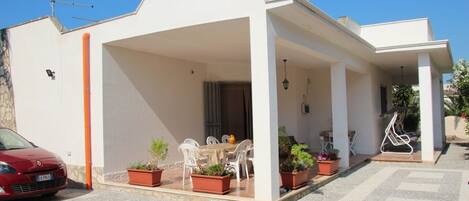
Villa 2 steps from the Ionian Sea, in the Salento, with a garden and private cou
San Pietro in Bevagna
Villa 2 steps from the Ionian Sea, in the Salento, with a garden and private cou
San Pietro in Bevagna
- Cocina
- Lavadora
- Acepta mascotas
- Aire acondicionado
10.0 de 10, Excepcional, (2 opiniones)
10/10
Excepcional
(2 opiniones)
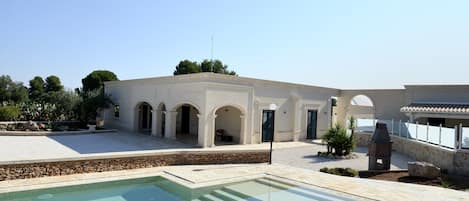
Corte del Sole
Manduria
Corte del Sole
Manduria
- Alberca
- Cocina
- Lavadora
- Wifi gratuito
9.8 de 10, Excepcional, (16 opiniones)
9.8/10
Excepcional
(16 opiniones)
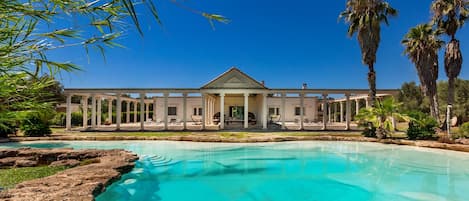
3086 Villa Artemide by Perle di Puglia
Sava
3086 Villa Artemide by Perle di Puglia
Sava
- Alberca
- Cocina
- Lavadora
- Acepta mascotas
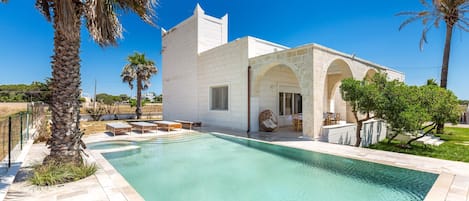
Villa Mirante by Perle di Puglia
Maruggio
Villa Mirante by Perle di Puglia
Maruggio
- Alberca
- Cocina
- Lavadora
- Acepta mascotas
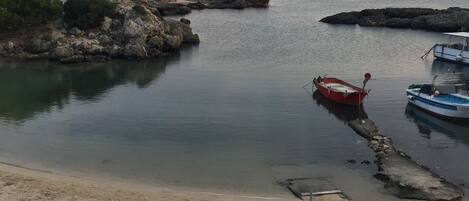
The Conchiglia is located in front of the “Baia del Pescatore” Leporano
Monti D'arena-bosco Caggione
The Conchiglia is located in front of the “Baia del Pescatore” Leporano
Monti D'arena-bosco Caggione
- Desayuno incluido
- Wifi gratuito
- Aire acondicionado
- Estacionamiento disponible
Información de la zona
Maruggio
Esta villa se encuentra en el campo de Maruggio. La belleza natural del área puede apreciarse en Playa de Punta Prosciutto y Dunas de Campomarino, mientras que Museo de la Segunda Guerra Mundial y Museo del Vino Primitivo son lugares culturales destacados. También vale la pena conocer Pista Go-kart y Reservas Naturales Litoral Tarantino Oriental. Las actividades como buceo y snorkel ofrecen una gran oportunidad de disfrutar del agua y, si buscas un poco de adrenalina, puedes hacer paseos a pie o ciclismo en senderos y ciclismo de montaña en los alrededores.

Campomarino, Puglia
Qué hay cerca
- Dunas de Campomarino - A 7 min a pie - 0.6 km
- Puerto de Campomarino - A 10 min a pie - 0.9 km
- Playa de Ayala - A 12 min a pie - 1.0 km
- Parroquia de la Natividad de la Virgen María - A 17 min en auto - 2.6 km
- Iglesia Matriz - A 17 min en auto - 2.6 km
Medios de transporte
- Estación de Manduria Sava - 23 min en auto
Restaurantes
- Da Giovanna - A 12 min a pie
- Agriturismo Masseria Giustiniani - A 12 min en auto
- Tuareg - A 9 min a pie
- Go Mama Cafè - A 4 min en auto
- Sandrino - A 4 min en auto
Dinos cómo podemos mejorar nuestro sitioEnviar comentarios

