
Vacation House of Tourism to Chuca
Photo gallery for Vacation House of Tourism to Chuca


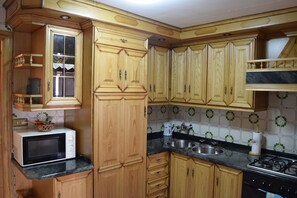

Popular amenities
- Onsite parking available
- Kitchen
- Washing machine
- Barbecue grill
- Internet access
- Fireplace
Explore the area
- Bande Roman Thermal BathsPlace, Bande Roman Thermal Baths47 min drive
- Aguas termales del Río Caldo en LobiosPlace, Aguas termales del Río Caldo en Lobios49 min drive
- Montalegre CastlePlace, Montalegre Castle50 min drive
Where you'll sleep
2 bedrooms (sleeps 5)
Bedroom 1
Bedroom 2
1 bathroom
Bathroom 1
Bathroom 2
Spaces
About this property
Vacation House of Tourism to Chuca
The vegetation of the Park includes both species from the Atlantic and Mediterranean borders. Oak melojares abound, which is accompanied by below 1000 meters by birches and at higher altitudes by Scots pine and yew. Chestnut, holly, cork oak, strawberry tree and also appear in the shrub layer, heather and piornos. In addition there are enclaves with repopulations, mainly of Pinuspinaster. The riverside forests around the water courses are mainly made of ash, alder, poplar, willow and hazelnut. Among the existing fauna we can mention open-field raptors, such as the kestrel and the buzzard or the eaglet. Also flying over the area are golden eagles, short-toed and retrievers. Among mammals, mention the presence of a small wolf colony, along with other species such as rabbit, roe deer, fox, otter or wild boar.
The environment is made up of small villages, where ancestral customs are still preserved. The Roman legions passed through here to conquer the Callaici tribe, that is, the Galaicos. At that time there was no border and it would still take time to do so. The same river with two variants. Limia for the Galicians who see him born in the fountains of Antela and Lima for the Portuguese who see him die in Viana do Castelo. The entire area is dominated by river courses. Numerous tributaries accompany the Limia, which houses three large reservoirs: the Salas (Requiás) As Conchas reservoir and the Lindoso reservoir. The latter with a dam in Portuguese territory and Galician water. However, this is a dry line because it is not the rivers but the mountains that, as we get closer, delimit the horizon with its profile of mountains. They are unmistakable with their characteristic peaks like castles. By altitude, they preserve the lowest glacial cirques in the Iberian Peninsula. From north to south, the Serra do Laboreiro and Queguas; the O Quinxo mountains; the Alto de Santa Eufemia, already a neighbor of the Serra do Xurés that stands at the highest point of all these mountainous areas at the peak of A Nevosa (1,539m); further west the Serra do Pisco in (Requisa) and further away the Serra da Pena and the lands of the Couto Mixto that in times did not belong to either Spain or Portugal.
The rugged rocky areas hunted the last bear in these latitudes and today they witness the return of the Xurés goat through a plan to reintroduce the wild goat into the wild. To preserve all diversity, one of the first community experiences of cross-border collaboration was launched. By rank, the Peneda-Gerês National Park (Portugal) together with the Baixa Limia-Serra do Xurés Natural Park form a single natural jewel of this old and new Gallaecia. The Portuguese part preserves very leafy areas with large trees that were formerly used to navigate as sleepers, frames and masts of fame in the seven seas. FLORA: Wide bushes with some endemisms such as Iris boissieri. Oak groves and Mediterranean elements of cork oaks (Quercus suber) and strawberry trees (Arbutus unedo). In the highest areas it is accompanied by wild pine (Pinus sylvestris) and yew (Taxus baccata).
WILDLIFE: Wolf packs (Canis lupus) and large prey: Roe deer (Capreolus capreolus) and Mountain goat in a reintroduction program. In the high plains and in semi-freedom, the horse called Galician Pony or Garrano (Equus cavallus). Sporadically, Águila real (Aquila chrysaetos ROUTES: The Baixa Limia-Serra do Xurés Natural Park is one of the protected areas with the greatest historical, ethnographic and environmental personality in the autonomous community. There are hiking trails that in some cases mimic the sections of the Via XVIII or Vía Nova that linked the Augustinian cities of Braga and Astorga. We can still touch road milestones in the Miliarios area, nine kilometers from Lobios on the ascent that leads to Portela do Home. From the north is this one of the entrances to the Portuguese National Park of Peneda-Gerês. To get there, you run in sight of the Caldo River. The thermal benefits to which its name refers can still be enjoyed today. A little further up it receives the brave stream of A Date, which flows into a waterfall. Full of rain it is the highest and most impressive in Galicia. That it is a zone of roads and stops is witnessed by the Aquis Querquennis site, a Roman camp in Bande, on the shore of the As Conchas reservoir. The site is being conditioned as a museum of Romanization. In the same municipality you can visit the first church in Galicia with a Visigoth plant or better to say Swedish, in Santa Comba. Around the Salas reservoir, in the municipality of Muíños, there are also hiking itineraries that are completed with an archaeological route.
A local road from the municipal capital in Mugueimes will lead us to the edge of its waters, with excellent possibilities for water sports, and to the megalithic remains of Casiña da Moura and Casola do Foxo. The native cattle perfectly adapted to the difficulties of the mountains is the Cachena cow, miniatures with long horns. They have been in danger of extinction. A good place to observe them is in the town hall of Entrimo. Specifically, accessing from the municipal capital in A Terrachá to Olelas, one of the most original villages in the province of Ourense ...
The climatic diversity imposes, in the Baixa Limia-Serra do Xurés Natural Park, two climates and, consequently, two different vegetation. One of the great attractions of this park is its landscape variety. As for the vegetation, this space is located between two large regions of European flora: the Eurosiberian, from the Atlantic province, and the Mediterranean, from the Carpetan-Leon province. Therefore, the vegetation alternates deciduous forests, characteristic of humid climatic zones, with those of evergreen. We find, then, melojo oak, birches (below 1,000 meters), chestnut, holly or heather. Among the fauna we must mention the kestrel, the buzzard, the viper and some wolves. In addition, there are rabbits, roe deer and wild boars. The inhabitants of the area take advantage of the land through pastures and fodder crops, alternating them with rye fallows.
For lovers of natural and cultural values Vegetation: Transition zone between two major European flower regions: the Eurosiberian (Atlantic province) and the Mediterranean (Carpetan-Leon province). For this reason, the vegetation alternates forests of deciduous trees, characteristic of humid climatic conditions, with those of evergreen, more adapted to the lack of water during certain periods of the year. The most widespread plant formation is the deciduous forest, with oak groves (Quercus Pyrenaica) and birch trees (Betula celtiberica), with the presence of strawberry trees and holly at the highest altitudes. There are several plant endemisms, including Prunus Iusitanica, a species that colonizes Barrancos and other areas of high humidity.
Fauna: Mammals: There is an ongoing recovery program for the horse (Equus cavallus) called the Galician Pony of Garrano, which lives semi-freely in the highlands (Leboreiro, O Quinxo, Santa Eufemia, Xurés ou Pisco). The fauna is very varied. Among the amphibians and reptiles we can mention the long-tailed salamander, the Iberian lizard and the viper snake. The two reservoirs located in the park are the habitat of important bird populations. Lesser grebes, mallards, loons and little harriers are some of them. The presence of the golden eagle, the tern, the goshawk, the sparrowhawk, the short-toed eagle, the kestrel, the cuckoo, the great spotted woodpecker and the swift are also observed. In addition to hunting species such as wild boar, roe deer, partridge, hare or rabbit, mammals are represented by wolf. common shrew, polecat otter, genet, bobcat and weasel. Trout appear in water courses.
Add dates for prices
Have a question?
BetaBetaGet instant answers with AI powered search of property information and reviews.
Similar properties

Casa das Inverneiras | Castro Laboreiro | Peneda-Gerês National Park
- Kitchen
- Pet-friendly
- Air-conditioning
- Outdoor space

Poço Verde Mill | River | Peneda-Gerês National Park | Laboreiro River
- Kitchen
- Pet-friendly
- Outdoor space
- Parking available

YourHouse A Casa Da Corona, beautiful country house
- Kitchen
- Washing machine
- Free Wi-Fi
- Outdoor space

OUTEIRO "TRAS OS MONTES PARC DU GERES 50€ for 2
- Pool
- Kitchen
- Washing machine
- Pet-friendly

Casa do Sertão T-2 in Viana do Castelo
- Kitchen
- Washing machine
- Parking available
- Barbecue grill

Casa da Pipela
- Pool
- Kitchen
- Pet-friendly
- Free Wi-Fi
Casa do Palheiro
- Kitchen
- Pet-friendly
- Air-conditioning
- Parking available

Refúgio da Rossaura | Assureira | Castro Laboreiro | Peneda Gerês National Park
- Kitchen
- Pet-friendly
- Air-conditioning
- Outdoor space

MAGNIFICENT LOCATION, FANTASTIC VIEW, PENEDA-manages PARK
- Kitchen
- Washing machine
- Free Wi-Fi
- Outdoor space

Chalet 'Cantinho De Tourem' with Mountain View, Private Terrace and Wi-Fi
- Kitchen
- Pet-friendly
- Free Wi-Fi
- Outdoor space

Double/Twin Room at the Castle Viewpoint in the heart of the Peneda-Gerês National Park
- Breakfast included

Triple Room at the Castle Viewpoint in the heart of the Peneda-Gerês National Park
- Breakfast included
- Free Wi-Fi
- Parking available
- Living/dining area

Self catering Soajonature for 4 people
- Pool
- Hot tub
- Kitchen
- Washing machine

El Cuco Apartment
- Breakfast included
- Kitchen
- Washing machine
- Pet-friendly

La Terrera Room
- Breakfast included
- Pet-friendly
- Free Wi-Fi
- Parking available
Mountain Lodge soajo Peneda-Geres
- Kitchen
- Washing machine
- Pet-friendly
- Outdoor space
House Rules
Check in after 4:00 PM
Check out before 11:00 AM
Children
Adults only
Events
No events allowed
Pets
No pets allowed
Smoking
Smoking is not permitted
Important information
You need to know
About the area
Muinos
What's nearby
- Church of Santa Comba - 40 min drive - 29.7 km
- Aquis Querquennis - 43 min drive - 32.2 km
- Bande Roman Thermal Baths - 47 min drive - 32.6 km
- Aguas termales del Río Caldo en Lobios - 49 min drive - 40.2 km
- Montalegre Castle - 50 min drive - 31.0 km
Restaurants
- Casa Do Preto - 17 min drive
- Restaurante Dom Pedro Pitões - 16 min drive
- Cafetería Wendy - 17 min drive
- Bar Taxi - 10 min drive
- O Esquecemento - 29 min drive
Frequently asked questions
Is Vacation House of Tourism to Chuca pet-friendly?
No, pets are not allowed at this property.
How much does it cost to stay at Vacation House of Tourism to Chuca?
As of 17 Sept, 2026, prices found for a 1-night stay for 2 adults at Vacation House of Tourism to Chuca on 26 Jan, 2027 start from S$547, including taxes and fees. This price is based on the lowest nightly price found in the last 24 hours for stays in the next 30 days. Prices are subject to change. Choose your dates for more accurate prices.
How much is parking at Vacation House of Tourism to Chuca?
On-site parking is available at the property.
What time is check-in at Vacation House of Tourism to Chuca?
Check-in begins at 4:00 PM.
What time is check-out at Vacation House of Tourism to Chuca?
Checkout is at 11:00 AM.
Where is Vacation House of Tourism to Chuca located?
Situated on the waterfront, this holiday home is within 20 miles (32 km) of Bande Roman Thermal Baths, Church of Santa Comba and Aquis Querquennis. Igrexa de San Fiz de Galez and Barroso Eco Museu are also within 20 miles (32 km).
About the host
Hosted by Celsa

Languages:
Spanish, Portuguese