
Casa entera·Alojamiento particular
Oasi del lupo ".La Villa ARTE del Lupo" Jewel in Tuscany near Arezzo
Galería de imágenes de Oasi del lupo ".La Villa ARTE del Lupo" Jewel in Tuscany near Arezzo


Comentarios
1010 de 10
Excepcional
Aspectos destacados
- Equipamiento de playaPoco común: equipamiento de playa para tus días junto al mar.
2 habitaciones1 baño4 huéspedes
Servicios populares
- Patio
- Piscina
- Gimnasio en las instalaciones
- Kitchenette
- Parrilla de barbacoa
- Aire acondicionado
Echa un vistazo a la zona

Subbiano, Arezzo
- Castillo de la FioraiaPlace, Castillo de la FioraiaA 22 min en coche
- Castelnuovo di SubbianoPlace, Castelnuovo di SubbianoA 25 min en coche
- ExpArtPlace, ExpArtA 33 min en coche
Habitaciones y camas
2 habitaciones (capacidad para 4 personas)
Habitación 1
1 cama doble
Habitación 2
1 cama doble
1 baño
Baño 1
Jabón · Toallas · WC · Solo ducha · Secador de pelo
Otros espacios
Porche o patio
Cocina
Minicocina
Jardín
Comedor
Acerca de este alojamiento
Oasi del lupo ".La Villa ARTE del Lupo" Jewel in Tuscany near Arezzo
Welcome to our hidden gem in Tuscany! Our beautiful retreat offers the perfect combination of art and relaxation under one roof. Come and relax in our peaceful oasis and unwind.
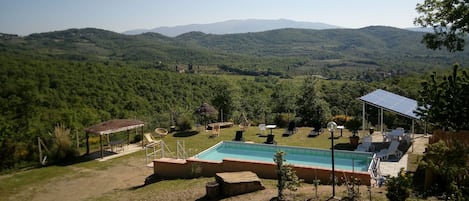
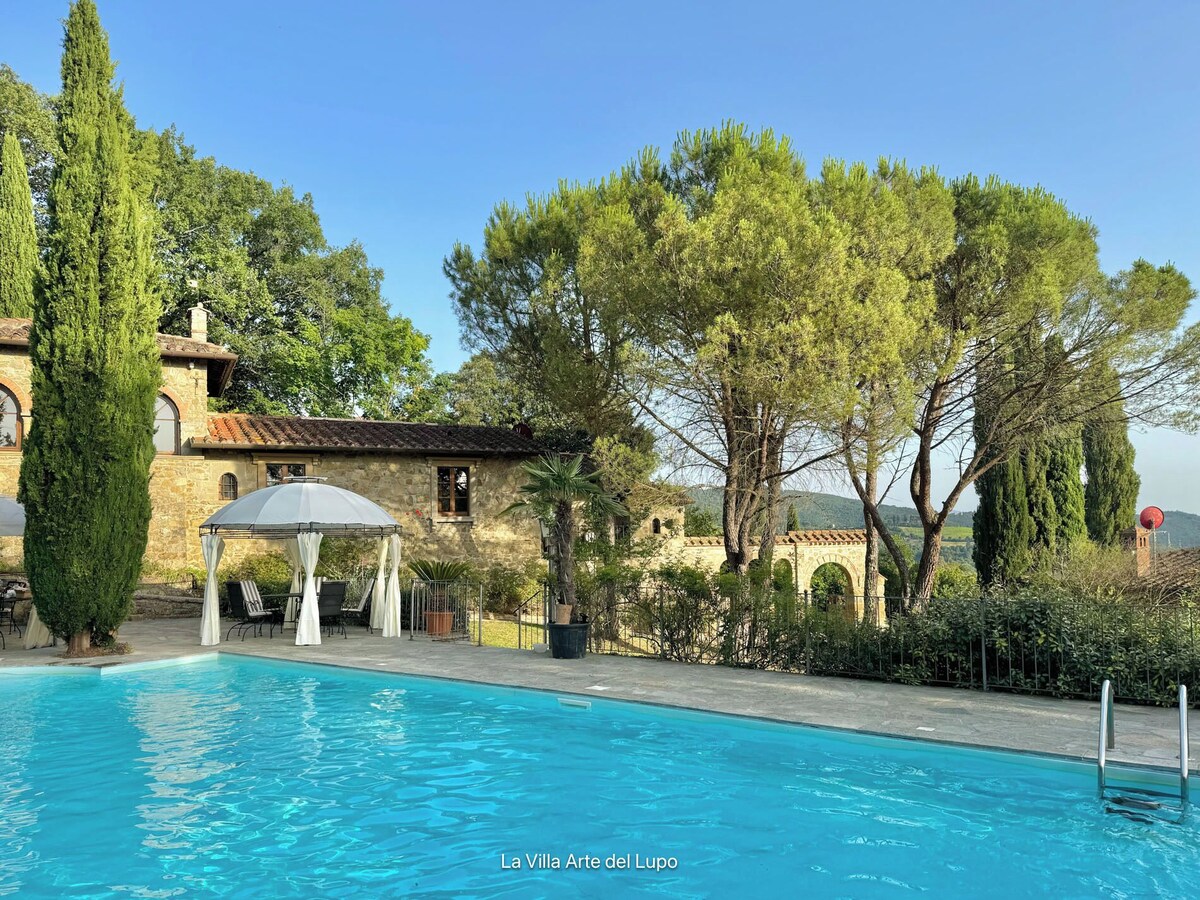
The villa has four cuddly golden retrievers whose gentle nature will make you forget everyday life. 4000 sqm garden with pool in a fantastic panoramic location. The pool house is on the grounds of "La Villa ARTE del Lupo"
Subbiano is in the middle of the most important sights and is therefore perfect for day trips to many famous cities, such as Florence, Siena, Pisa, Volterra, Montepulciano, Perugia,
Lake Trasimeno, Castiglione del Lago, Citta di Castello. Drive to the famous Val di Chiana. Visit La Villa with its delicacies. All of these dream destinations can be reached in between 15 minutes and 1.5 hours.
Anyone who has a dream should go to Italy.
It doesn't matter if you think the dream is dead and buried,
in Italy it will rise again and come true
(Elizabeth Spencer)
The Villa del ARTE del Lupo – Not just a place to stay…
FROM WAYNE ANTHONY-08-2024
Nestled atop the rolling hills of Tuscany, the Villa del ARTE del Lupo offers not only a relaxing place to
stay, but a place where history, art, and mysticism converge in a glimpse of Italy’s historic past. The
property has served various purposes over its long life: a rest stop for travelers, a religious retreat, an
extensive family home, and now a place for guests to experience the beauty of Tuscany. While enjoying
a relaxing stay, however, guests should make time to explore the unique grounds, which, with open
eyes, give the keen observer a chance to explore a slice of the unique two-thousand year history of the
Italian countryside.
For the curious, consider a simple stroll around the property. Terraces carefully cut into the land provide
level areas for agriculture. Massive fig trees and orchards once offered fruit in their season. Cisterns,
now dry, attest to hidden Roman engineering. Traces of ancient lanes lead to hidden groves, pavilions,
and bowers, lost to the mysteries of time.
In fact, the approach to the Villa is one of the primary roads of ancient Rome, the Via Romea Germanica.
Around 1236 AD, this way transformed into a religious pilgrimage route linking Stade, Germany in the
north to the Vatican at Rome in the south. This historic road passes directly in front of the main Villa,
bisecting the land. Today, it is marked with two historical markers citing the mileage to either terminus.
Approaching the Villa from the south on this road and traveling up the hill, the land is lined with several
vineyards, fruit groves, and farms which originally provided food for the estate above. Aging
outbuildings still remain gently slipping away, a testament to effects of time. Small access lanes, now
wildly overgrown, wind away and lead to places long forgotten. As the house nears, on the left a storage
area, erected by a former owner, boasts stacked remains of historic stone work rescued from the
surrounding countryside. Upon arrival at the Villa, four unique markers clearly delineate the beginning
of the main compound.
The first of these sits to the right of the road, a large, arch-shaped stone. Protruding from its flat face, a
carved relief of an unknown pagan deity stands sentinel. Its features have been brutally defaced,
possibly in the Middle Ages, when the site was transformed from a pagan wayside to a Christian
nunnery, but its placement is clear. Even the early Romans sought the gods’ protection of their land.
On the left, across from the stone marker, sits the corner wall of the main entrance. Herein is set a
definitive reminder of the Christian conversion. An icon of Michael the Archangel defeating the Dragon
of Evil (Revelation 12:7 in the Bible), proclaims a notice of divine protection--no evil dare enter this
sacred site. In his hands, Michael wields a sword of victory and holds the scales of justice weighing the
hearts of all. His foot crushes the head of the defeated dragon.
Before the shrine is placed a kneeling plinth for prayer. To the right, a candle nook offers light to the way
of the pilgrims. Within the nook is the seal of the Grand Master of the Knight’s Templar, showing their
approval and use of the land as a safe haven for pilgrims. A Templer Knight with shield rides his steed;
circling is the Templar motto: Cristi sigillum militum (Seal of the Soldiers of Christ). Above, inscribed in
the plaster work, are the words “Io credo” (I believe). To the right of this sits an ambiguous symbol--a
circle with four petals, possibly a Greek Chi (the symbol of Christ) or a marker of the four Gospels
(Matthew, Mark, Luke, and John).
Continuing down the wall to the left of the icon, is another pair of markers. First, a half circle niche
which most likely held a statue of a local pagan god, is now bricked over. Then, a fresco triumvirate of
three women bathing naked in a spring, possibly water nymphs, is beside. In the far background of the
fresco, a depiction of the Villa can be seen. This enigmatic artwork stands in direct opposition to its
Christian neighbors--that is until entering the property through the passage just beside. Behind, not fifty
feet from the image is a well, a sacred spring. The fresco is a beacon for travelers on the road that there
is water for the thirsty weary available. This wellspring is likely an outlet of another amazing feature of
this property: through a variety of hidden underground waterways, the entire complex is feed water
directly from a hidden lake further up the hill
Finally, moving another twenty feet further down the entrance wall, is a final historical feature. Built
into the wall are the durchreiche, or ‘pass throughs.’ These two large, brick-lined circular openings date
from the time the property housed a cloistered nunnery. They allowed the surrounding community to
bring supplies to the Order, and pass these through to those cloistered and secluded within.
From this point, returning the Via Romane, the property unfolds. A tall stone wall lines the road to the
right. This creates a terrace on the hill above upon which sets the various buildings of the main property.
This wall opens to a car park beyond which and below lies a terraced planting area which most likely
served as kitchen garden for the medieval nunnery. Above this terrace, across the Roman road, is an
area which formed a meditation garden (not accessible as a part of the current property).
The rest of the complex consists of a sprawling number of buildings which have been adapted and
adorned by the work of the last previous owner. The grounds sport stoneware salvaged from the
surrounding countryside. Animals, water basins, and reclaimed building materials are artistically
incorporated everywhere and are worth a careful examination. Cast a glance upward as well, as the
stonework is even incorporate into the chimneys and roof features.
Finally, the four corners of main house’s eave are adorned with metal lilies, the symbol of
Easter—resurrection, hope, rebirth and blessing. This seems a curious addition until entering the
house’s kitchen. Just inside, a nook houses a painted icon of Mary holding Jesus. She keeps watch over
all who enter, and in his hands, the Christ Child holds a sprig of lilies, clearly the symbol of His blessing
and favor upon the house and all who enter.
Host:
Tammy and Ulli
About us
"Having fun in life is the best cosmetic for a woman."
Tammy a strong, beautiful woman at Ulli's side
Press release ULRICH HM WOLF:
Paris Hilton, Londonbeat, Natascha Wright (La Bouche) Thomas Anders, Weathergirls, Markus, Marjike Amado, Udo Jürgens and many others have been in front of the camera in his model villa in Taunusstein/Hessen and now Subbiano in Tuscany - that's where he likes to work most after his many travels. "The special, slow-paced, concentrated atmosphere in my refuge is often the basis for the extraordinary moment that needs to be shown," emphasizes photo psychologist and people expert Ulrich HM Wolf, who is unusually reserved for the media environment. A big city is not an option for his home base. After arriving from Berlin, London, NY, Milan, etc., it quickly becomes clear to everyone who comes for the first time: the warm atmosphere is unique and visible.?
The latest creation is called FACES - unique art portraits of predominantly famous faces.
The villa has four cuddly golden retrievers whose gentle nature will make you forget everyday life. 4000 sqm garden with pool in a fantastic panoramic location. The pool house is on the grounds of "La Villa ARTE del Lupo"
Subbiano is in the middle of the most important sights and is therefore perfect for day trips to many famous cities, such as Florence, Siena, Pisa, Volterra, Montepulciano, Perugia,
Lake Trasimeno, Castiglione del Lago, Citta di Castello. Drive to the famous Val di Chiana. Visit La Villa with its delicacies. All of these dream destinations can be reached in between 15 minutes and 1.5 hours.
Anyone who has a dream should go to Italy.
It doesn't matter if you think the dream is dead and buried,
in Italy it will rise again and come true
(Elizabeth Spencer)
The Villa del ARTE del Lupo – Not just a place to stay…
FROM WAYNE ANTHONY-08-2024
Nestled atop the rolling hills of Tuscany, the Villa del ARTE del Lupo offers not only a relaxing place to
stay, but a place where history, art, and mysticism converge in a glimpse of Italy’s historic past. The
property has served various purposes over its long life: a rest stop for travelers, a religious retreat, an
extensive family home, and now a place for guests to experience the beauty of Tuscany. While enjoying
a relaxing stay, however, guests should make time to explore the unique grounds, which, with open
eyes, give the keen observer a chance to explore a slice of the unique two-thousand year history of the
Italian countryside.
For the curious, consider a simple stroll around the property. Terraces carefully cut into the land provide
level areas for agriculture. Massive fig trees and orchards once offered fruit in their season. Cisterns,
now dry, attest to hidden Roman engineering. Traces of ancient lanes lead to hidden groves, pavilions,
and bowers, lost to the mysteries of time.
In fact, the approach to the Villa is one of the primary roads of ancient Rome, the Via Romea Germanica.
Around 1236 AD, this way transformed into a religious pilgrimage route linking Stade, Germany in the
north to the Vatican at Rome in the south. This historic road passes directly in front of the main Villa,
bisecting the land. Today, it is marked with two historical markers citing the mileage to either terminus.
Approaching the Villa from the south on this road and traveling up the hill, the land is lined with several
vineyards, fruit groves, and farms which originally provided food for the estate above. Aging
outbuildings still remain gently slipping away, a testament to effects of time. Small access lanes, now
wildly overgrown, wind away and lead to places long forgotten. As the house nears, on the left a storage
area, erected by a former owner, boasts stacked remains of historic stone work rescued from the
surrounding countryside. Upon arrival at the Villa, four unique markers clearly delineate the beginning
of the main compound.
The first of these sits to the right of the road, a large, arch-shaped stone. Protruding from its flat face, a
carved relief of an unknown pagan deity stands sentinel. Its features have been brutally defaced,
possibly in the Middle Ages, when the site was transformed from a pagan wayside to a Christian
nunnery, but its placement is clear. Even the early Romans sought the gods’ protection of their land.
On the left, across from the stone marker, sits the corner wall of the main entrance. Herein is set a
definitive reminder of the Christian conversion. An icon of Michael the Archangel defeating the Dragon
of Evil (Revelation 12:7 in the Bible), proclaims a notice of divine protection--no evil dare enter this
sacred site. In his hands, Michael wields a sword of victory and holds the scales of justice weighing the
hearts of all. His foot crushes the head of the defeated dragon.
Before the shrine is placed a kneeling plinth for prayer. To the right, a candle nook offers light to the way
of the pilgrims. Within the nook is the seal of the Grand Master of the Knight’s Templar, showing their
approval and use of the land as a safe haven for pilgrims. A Templer Knight with shield rides his steed;
circling is the Templar motto: Cristi sigillum militum (Seal of the Soldiers of Christ). Above, inscribed in
the plaster work, are the words “Io credo” (I believe). To the right of this sits an ambiguous symbol--a
circle with four petals, possibly a Greek Chi (the symbol of Christ) or a marker of the four Gospels
(Matthew, Mark, Luke, and John).
Continuing down the wall to the left of the icon, is another pair of markers. First, a half circle niche
which most likely held a statue of a local pagan god, is now bricked over. Then, a fresco triumvirate of
three women bathing naked in a spring, possibly water nymphs, is beside. In the far background of the
fresco, a depiction of the Villa can be seen. This enigmatic artwork stands in direct opposition to its
Christian neighbors--that is until entering the property through the passage just beside. Behind, not fifty
feet from the image is a well, a sacred spring. The fresco is a beacon for travelers on the road that there
is water for the thirsty weary available. This wellspring is likely an outlet of another amazing feature of
this property: through a variety of hidden underground waterways, the entire complex is feed water
directly from a hidden lake further up the hill
Finally, moving another twenty feet further down the entrance wall, is a final historical feature. Built
into the wall are the durchreiche, or ‘pass throughs.’ These two large, brick-lined circular openings date
from the time the property housed a cloistered nunnery. They allowed the surrounding community to
bring supplies to the Order, and pass these through to those cloistered and secluded within.
From this point, returning the Via Romane, the property unfolds. A tall stone wall lines the road to the
right. This creates a terrace on the hill above upon which sets the various buildings of the main property.
This wall opens to a car park beyond which and below lies a terraced planting area which most likely
served as kitchen garden for the medieval nunnery. Above this terrace, across the Roman road, is an
area which formed a meditation garden (not accessible as a part of the current property).
The rest of the complex consists of a sprawling number of buildings which have been adapted and
adorned by the work of the last previous owner. The grounds sport stoneware salvaged from the
surrounding countryside. Animals, water basins, and reclaimed building materials are artistically
incorporated everywhere and are worth a careful examination. Cast a glance upward as well, as the
stonework is even incorporate into the chimneys and roof features.
Finally, the four corners of main house’s eave are adorned with metal lilies, the symbol of
Easter—resurrection, hope, rebirth and blessing. This seems a curious addition until entering the
house’s kitchen. Just inside, a nook houses a painted icon of Mary holding Jesus. She keeps watch over
all who enter, and in his hands, the Christ Child holds a sprig of lilies, clearly the symbol of His blessing
and favor upon the house and all who enter.
Host:
Tammy and Ulli
About us
"Having fun in life is the best cosmetic for a woman."
Tammy a strong, beautiful woman at Ulli's side
Press release ULRICH HM WOLF:
Paris Hilton, Londonbeat, Natascha Wright (La Bouche) Thomas Anders, Weathergirls, Markus, Marjike Amado, Udo Jürgens and many others have been in front of the camera in his model villa in Taunusstein/Hessen and now Subbiano in Tuscany - that's where he likes to work most after his many travels. "The special, slow-paced, concentrated atmosphere in my refuge is often the basis for the extraordinary moment that needs to be shown," emphasizes photo psychologist and people expert Ulrich HM Wolf, who is unusually reserved for the media environment. A big city is not an option for his home base. After arriving from Berlin, London, NY, Milan, etc., it quickly becomes clear to everyone who comes for the first time: the warm atmosphere is unique and visible.?
The latest creation is called FACES - unique art portraits of predominantly famous faces.
Añade las fechas para ver los precios
Alojamientos similares

Casa rural en Toscana con piscina y vistas
Poppi
Casa rural en Toscana con piscina y vistas
Poppi
- Piscina
- Cocina
- Lavadora
- Wifi gratis
10.0 sobre 10, Excepcional, (10 comentarios)
10/10
Excepcional
(10 comentarios)

Castagno-Gemme del Casentino
Castel Focognano
Castagno-Gemme del Casentino
Castel Focognano
- Piscina
- Cocina
- Wifi gratis
- Aire acondicionado
10.0 sobre 10, Excepcional, (1 comentario)
10/10
Excepcional
(1 comentario)

Tuscan farmhouse on a beautiful hill with grounds and a private pool, 2 bedrooms
Anghiari
Tuscan farmhouse on a beautiful hill with grounds and a private pool, 2 bedrooms
Anghiari
- Piscina
- Wifi gratis
- Aparcamiento disponible
- Servicios de lavandería
10.0 sobre 10, Excepcional, (29 comentarios)
10/10
Excepcional
(29 comentarios)

Preciosa casa de vacaciones privada con WIFI, piscina privada, A/C, TV, patio, cerca de Arezzo
Pergine Valdarno
Preciosa casa de vacaciones privada con WIFI, piscina privada, A/C, TV, patio, cerca de Arezzo
Pergine Valdarno
- Piscina
- Cocina
- Lavadora
- Se aceptan mascotas
10.0 sobre 10, Excepcional, (51 comentarios)
10/10
Excepcional
(51 comentarios)

Il Moro-Gemme del Casentino
Castel Focognano
Il Moro-Gemme del Casentino
Castel Focognano
- Piscina
- Cocina
- Wifi gratis
- Aire acondicionado
10.0 sobre 10, Excepcional, (1 comentario)
10/10
Excepcional
(1 comentario)
![Exterior casa de vacaciones [verano]](https://media.vrbo.com/lodging/102000000/101580000/101571500/101571456/4fd52f4a.jpg?impolicy=fcrop&w=469&h=201&p=1&q=medium)
Elegante refugio en el campo
Città di Castello
Elegante refugio en el campo
Città di Castello
- Piscina
- Cocina
- Se aceptan mascotas
- Wifi gratis
9.4 sobre 10, Excepcional, (29 comentarios)
9,4/10
Excepcional
(29 comentarios)

Terrazzina is a charming flat in the hamlet of Castello di Montozzi
Toscana
Terrazzina is a charming flat in the hamlet of Castello di Montozzi
Toscana
- Piscina
- Cocina
- Lavadora
- Se aceptan mascotas
10.0 sobre 10, Excepcional, (1 comentario)
10/10
Excepcional
(1 comentario)

Apartamento ROSA con entrada privada, amplio jardín y piscina.
Pergine Valdarno
Apartamento ROSA con entrada privada, amplio jardín y piscina.
Pergine Valdarno
- Piscina
- Cocina
- Lavadora
- Se aceptan mascotas
10.0 sobre 10, Excepcional, (1 comentario)
10/10
Excepcional
(1 comentario)

Gorgeous home in Bibbiena
Bibbiena
Gorgeous home in Bibbiena
Bibbiena
- Piscina
- Cocina
- Se aceptan mascotas
- Wifi gratis
10.0 sobre 10, Excepcional, (1 comentario)
10/10
Excepcional
(1 comentario)

AMARILLO edificio de apartamentos en la hermosa casa de campo toscana con jardín
Pergine Valdarno
AMARILLO edificio de apartamentos en la hermosa casa de campo toscana con jardín
Pergine Valdarno
- Piscina
- Cocina
- Lavadora
- Se aceptan mascotas
10.0 sobre 10, Excepcional, (3 comentarios)
10/10
Excepcional
(3 comentarios)

Borgo dei Corsi - VERGAIO 6 Apartment
Raggiolo
Borgo dei Corsi - VERGAIO 6 Apartment
Raggiolo
- Piscina
- Desayuno incluido
- Cocina
- Lavadora
9.4 sobre 10, Excepcional, (17 comentarios)
9,4/10
Excepcional
(17 comentarios)

Casa rural cerca de la vida nocturna
Terranova Bracciolini, Arezzo
Casa rural cerca de la vida nocturna
Terranova Bracciolini, Arezzo
- Piscina
- Cocina
- Lavadora
- Se aceptan mascotas
9.8 sobre 10, Excepcional, (11 comentarios)
9,8/10
Excepcional
(11 comentarios)

Casa Vacanze - Casa di Pietro Aretino, muy céntrica Arezzo
Arezzo Centro Storico
Casa Vacanze - Casa di Pietro Aretino, muy céntrica Arezzo
Arezzo Centro Storico
- Cocina
- Lavadora
- Se aceptan mascotas
- Wifi gratis
10.0 sobre 10, Excepcional, (12 comentarios)
10/10
Excepcional
(12 comentarios)

Bonito apartamento para 6 personas con piscina, WIFI, TV y mascotas permitida, cerca de Arezzo
Capolona
Bonito apartamento para 6 personas con piscina, WIFI, TV y mascotas permitida, cerca de Arezzo
Capolona
- Cocina
- Lavadora
- Se aceptan mascotas
- Wifi gratis
10.0 sobre 10, Excepcional, (2 comentarios)
10/10
Excepcional
(2 comentarios)

Impresionante casa en Talla con WiFi
Talla
Impresionante casa en Talla con WiFi
Talla
- Cocina
- Lavadora
- Se aceptan mascotas
- Wifi gratis
9.0 sobre 10, Increíble, (2 comentarios)
9,0/10
Increíble
(2 comentarios)
Preciosa casa de vacaciones privada con WIFI, piscina privada, A/C, TV, patio, cerca de Arezzo
Pieve San Giovanni
Preciosa casa de vacaciones privada con WIFI, piscina privada, A/C, TV, patio, cerca de Arezzo
Pieve San Giovanni
- Piscina
- Cocina
- Lavadora
- Se aceptan mascotas
9.2 sobre 10, Increíble, (10 comentarios)
9,2/10
Increíble
(10 comentarios)

Casale Elisa es una encantadora casa de campo en una posición montañosa con impresionantes vistas de la
Arezzo
Casale Elisa es una encantadora casa de campo en una posición montañosa con impresionantes vistas de la
Arezzo
- Piscina
- Cocina
- Lavadora
- Espacio al aire libre
8.0 sobre 10, Muy bueno, (1 comentario)
8,0/10
Muy bueno
(1 comentario)
![Vista casa de vacaciones [verano]](https://media.vrbo.com/lodging/102000000/101570000/101565000/101564973/e8bc8c1c.jpg?impolicy=fcrop&w=469&h=201&p=1&q=medium)
Encantadora casa de campo toscana
Ortignano
Encantadora casa de campo toscana
Ortignano
- Piscina
- Se aceptan mascotas
- Aparcamiento disponible
- Servicios de lavandería
10.0 sobre 10, Excepcional, (11 comentarios)
10/10
Excepcional
(11 comentarios)

Casa La Ciucola, piedra rústica para dos familias rodeada de vegetación
Raggiolo (Ar)
Casa La Ciucola, piedra rústica para dos familias rodeada de vegetación
Raggiolo (Ar)
- Piscina
- Bañera de hidromasaje
- Cocina
- Lavadora
9.6 sobre 10, Excepcional, (4 comentarios)
9,6/10
Excepcional
(4 comentarios)
Normas del alojamiento
Hora de comienzo del registro de entrada: 16:00
Edad mínima para alquilar: 18
Hora límite del registro de salida: 12:30
Menores
Solo para adultos
Eventos
No se permiten eventos
Mascotas
No se admiten mascotas
Fumadores
Se permite fumar (solo en las áreas designadas)
Información importante
Otros detalles
Número de registro de la propiedad IT051002C235ZRT9KL
Número de alojamiento: 5538102
Este alojamiento está gestionado por un propietario particular (es decir, una parte que no actúa dentro de su mercado, negocio o profesión). No se aplicará la legislación de protección de consumidores de la UE a tu reserva, incluido el derecho de desistimiento. La política de cancelación establecida por el propietario particular cubrirá tu reserva.
Puede aplicarse un recargo por cada persona adicional, según la política del alojamiento.
A tu llegada, pueden pedirte un documento de identidad oficial con foto y una tarjeta de crédito o débito, o un depósito en efectivo, para cubrir los gastos imprevistos.
No se garantizan las solicitudes especiales, que están sujetas a disponibilidad en el momento de la llegada y pueden suponer un recargo adicional.
Está terminantemente prohibido celebrar fiestas u otros eventos en grupo en las instalaciones.
El propietario no ha indicado si el alojamiento cuenta con un detector de monóxido de carbono, puede que te interese llevar uno portátil para el viaje.
El propietario ha indicado que el alojamiento cuenta con un detector de humo.
Información sobre la zona
Subbiano
Esta villa se encuentra en Subbiano, en un entorno rural y en la ribera de un río. Castillo de la Fioraia y Castelnuovo di Subbiano son algunos de los lugares emblemáticos de la región, donde también puedes acercarte a atractivos turísticos como Molino de Aceite Ravagni y Fattoria La Vialla.

Subbiano, Arezzo
Qué hay en los alrededores
- Castillo de la Fioraia - A 22 min en coche - 8.9 km
- Castelnuovo di Subbiano - A 25 min en coche - 10.4 km
- ExpArt - A 33 min en coche - 21.3 km
- Centro de equitación de Arezzo - A 50 min en coche - 32.4 km
- Plaza Grande - A 53 min en coche - 24.1 km
Cómo moverse por la zona
- Estación de tren de Subbiano: 14 min en coche
- Aeropuerto de Peretola (FLR): a 94 min en coche
Restaurantes
- Antico Posto di Ristoro - A 47 min en coche
- Buca di Michelangelo - A 51 min en coche
- La Corte dell'Oca - A 30 min en coche
- Ristorante Il Rifugio - A 53 min en coche
- Ristorante Il Cerro - A 50 min en coche
Preguntas frecuentes
¿En Oasi del lupo ".La Villa ARTE del Lupo" Jewel in Tuscany near Arezzo hay piscina?
Sí, este alojamiento cuenta con una piscina al aire libre.
¿En Oasi del lupo ".La Villa ARTE del Lupo" Jewel in Tuscany near Arezzo se aceptan mascotas?
No, este alojamiento no admite mascotas.
¿Cuál es el precio del aparcamiento en Oasi del lupo ".La Villa ARTE del Lupo" Jewel in Tuscany near Arezzo?
El alojamiento cuenta con estacionamiento propio.
¿A qué hora se realiza la entrada en Oasi del lupo ".La Villa ARTE del Lupo" Jewel in Tuscany near Arezzo?
Hora de inicio del registro de entrada: 16:00.
¿A qué hora se realiza la salida en Oasi del lupo ".La Villa ARTE del Lupo" Jewel in Tuscany near Arezzo?
La salida se realiza a las 12:30.
¿Dónde se encuentra Oasi del lupo ".La Villa ARTE del Lupo" Jewel in Tuscany near Arezzo?
En la ribera de un río, esta villa se encuentra a 2,9 km de Río Arno y a menos de 15 kilómetros de Castillo de la Fioraia y Castelnuovo di Subbiano. Iglesia parroquial de San Martino Sopr'Arno y Reserva Natural Monti Rognosi también están a menos de 20 kilómetros.
Acerca de su propietario/a
Propietario/a: Ulrich Wolf
Idiomas:
Inglés, Alemán
Dinos cómo podemos mejorar nuestro sitio webCompartir opinión