Apartamento
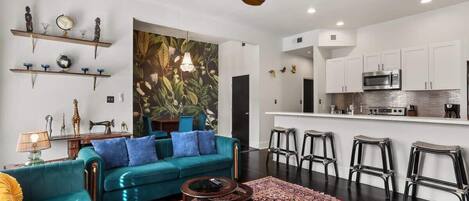
Stylish Escape in Historic Warehouse District
Galeria de fotos de Stylish Escape in Historic Warehouse District


Avaliações
Hóspedes adoram
9,8 de 10, Hóspedes adoramEntre as melhores avaliações de hóspedes nesta áreaEntre as melhores avaliações de hóspedes nesta área
Destaques
- Diversão em família espera por vocêEsta propriedade conta com boas avaliações por parte de famílias.
- JogosPropriedades com jogos disponíveis no local são uma raridade na área.
- Localização centralLocalização conveniente para que você nunca fique longe de onde precisa estar.
- Descubra os pontos de referência nos arredoresNos arredores de Canal Street
Comodidades populares
- Estacionamento no local disponível
- Aceita cães
- Cozinha
- Lava-roupa
- Ar-condicionado
- Sacada
Explore a região

New Orleans, LA
- National World War II MuseumPlace, National World War II Museum3 min de caminhada
- Ernest N. Morial Convention CenterPlace, Ernest N. Morial Convention Center8 min de caminhada
- Caesars New Orleans CasinoPlace, Caesars New Orleans Casino8 min de caminhada
- Nova Orleans, Luisiana (MSY-Aeroporto Internacional de New Orleans Louis Armstrong)Airport, Nova Orleans, Luisiana (MSY-Aeroporto Internacional de New Orleans Louis Armstrong)20 min de carro
Quartos e camas
2 quartos (acomoda 4 pessoas)
Quarto 1
1 cama Queen
Quarto 2
1 cama King
2 banheiros
Banheiro 1
Vaso sanitário · Apenas chuveiro
Banheiro 2
Banheira ou chuveiro · Vaso sanitário · Banheira de hidromassagem
Espaços
Deque ou pátio
Cozinha
Sacada
Espaço para refeições
Sobre esta propriedade
Stylish Escape in Historic Warehouse District
The elegant townhouse at 838 Camp Street was designed by James Harrison Dakin (1806-1852), an influential architect in New Orleans who also designed the landmark St. Patrick’s Cathedral down the street. The land was first owned by Gasquet, Parish & Co., a commission merchant company largely responsible for the initial development of the American Sector. Construction on this townhouse, originally one of nine sister “rowhouses,” began in the early 1840s.
The first known inhabitant of the townhouse was Walter Cox, a cotton merchant and owner of the cotton firm W. Cox & Co. established in 1858. It appears that the Civil War resulted in Cox’s firm going bankrupt, as his home was sold in a sheriff’s auction in 1867. The house was purchased by attorney Alfred J. Philips, partner in the esteemed New Orleans firm of Roselins & Philips. Sometime during the 1870s, ownership of the property transferred from Philips to his brother-in-law, influential attorney John Blackstone Cotton from Georgia, who married Alfred’s younger sister Sophia in 1852. Blackstone served as a New Orleans City Attorney in 1850, as a District Judge (1853-1857) and as Superintendent of Elections (1857-1858). During the Civil War, Cotton served as a Confederate Army Officer from 1861 until he fell ill in the field in 1862.
Margaret Robinson Barnett (1887–1977) purchased the property in May of 1921. Margaret owned and operated “Dixie Stove Works” out of what is now the property’s commercial space at 840 Camp. The company boasted itself as “the South’s largest manufacturer of stove parts.” Margaret and her husband also housed “Roomers” in the properties residential units beginning in 1930. These renters hailed from such varied places as Germany, New York, Louisiana, Minnesota, and South Dakota. The residence had become primarily commercial in the latter half of the 20th century, with Dixie Stove Works as its last commercial occupant.
The first known inhabitant of the townhouse was Walter Cox, a cotton merchant and owner of the cotton firm W. Cox & Co. established in 1858. It appears that the Civil War resulted in Cox’s firm going bankrupt, as his home was sold in a sheriff’s auction in 1867. The house was purchased by attorney Alfred J. Philips, partner in the esteemed New Orleans firm of Roselins & Philips. Sometime during the 1870s, ownership of the property transferred from Philips to his brother-in-law, influential attorney John Blackstone Cotton from Georgia, who married Alfred’s younger sister Sophia in 1852. Blackstone served as a New Orleans City Attorney in 1850, as a District Judge (1853-1857) and as Superintendent of Elections (1857-1858). During the Civil War, Cotton served as a Confederate Army Officer from 1861 until he fell ill in the field in 1862.
Margaret Robinson Barnett (1887–1977) purchased the property in May of 1921. Margaret owned and operated “Dixie Stove Works” out of what is now the property’s commercial space at 840 Camp. The company boasted itself as “the South’s largest manufacturer of stove parts.” Margaret and her husband also housed “Roomers” in the properties residential units beginning in 1930. These renters hailed from such varied places as Germany, New York, Louisiana, Minnesota, and South Dakota. The residence had become primarily commercial in the latter half of the 20th century, with Dixie Stove Works as its last commercial occupant.