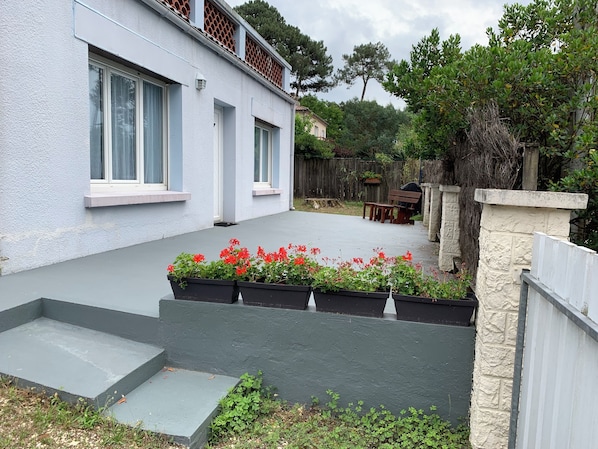
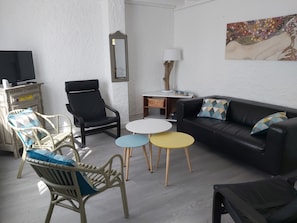
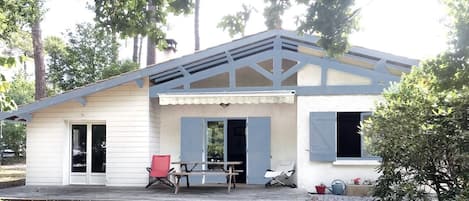
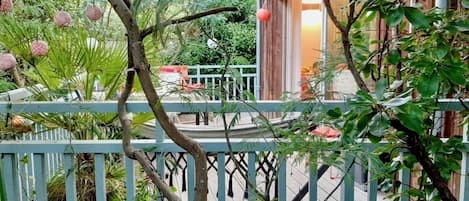
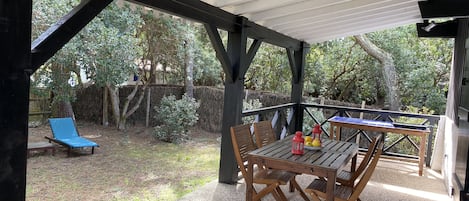
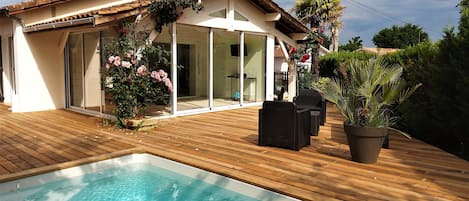
With spacious, bright, and comfortable rooms, the villa offers you all the necessary amenities to ensure a pleasant vacation both in the villa and in the private garden.
You can park in the large lot in front of the villa, which makes your arrival easier.
There are also several shops nearby, such as a bakery/pastry shop/ice cream parlor where you can get croissants for breakfast.
Discounts are available starting from the second week; please contact us for further details.
Bed linens and pillowcases (including for the neck pillow) are not provided (you can rent bedding 800 m from the villa and pay directly at the rental shop).
Oysters from Arcachon and Cap Ferret—a product of Aquitaine—what a treat!
It all starts with the water.... The oysters are raised for over 3 years and feed on plankton carried in by the current in the tank, under the watchful eye of the “farmers of the sea.” Let yourself be tempted by this fresh delicacy, in which iodine and salt leave a nutty aftertaste.
A bit of history:
It was Napoleon III who introduced oyster farming in 1856 and created the first imperial park in Arcachon. He sent Jean-Michel Coste, a Breton naturalist and professor at the Collège de France, to scientifically organize the search for oysters.
Simply scraping oysters off the beds is dangerous for them in the long run: Coste favored the method of selectively catching free-swimming oyster larvae, a technique that oyster farmers in the basin still use today.Coste is also credited with inventing the first collection device in 1859—a device that gathers and brings together oyster larvae to establish an oyster farm. The mason Michelet also played his part by inventing the “chaulage” technique in 1865: the process of coating bricks with a lime-sand mixture, which allows oyster farmers to catch the young oysters without damaging them.
Oysters from Arcachon and Cap Ferret—a product of Aquitaine—what a delight!
It all starts with the water.... The oysters are raised for over three years and feed on plankton carried in by the current in the basin, under the watchful eye of the “farmers of the sea.” Let yourself be tempted by this fresh delicacy, in which iodine and salt leave a nutty aftertaste.
A bit of history:
It was Napoleon III who introduced oyster farming in 1856 and created the first imperial park in Arcachon. He sent Jean-Michel Coste, a Breton naturalist and professor at the Collège de France, to scientifically organize the search for oysters.
Simply scraping oysters off the beds is dangerous for them in the long run: Coste preferred the method of selectively catching free-swimming oyster larvae, a technique that oyster farmers in the basin still use today.Coste is also credited with inventing the first collection device in 1859—a device that gathers and brings together oyster larvae to establish an oyster farm. The mason Michelet also played his part by inventing the “chaulage” technique in 1865: the process of coating bricks with a lime-sand mixture, which allows oyster farmers to catch the young oysters without damaging them.