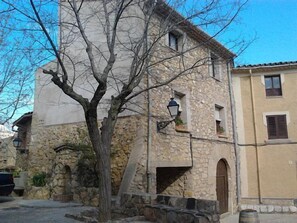
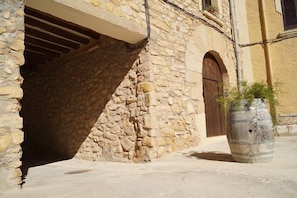
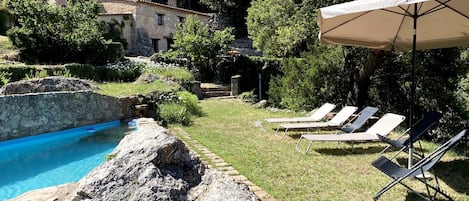
La Falconera is a holiday rental located in the municipality of La Morera de Montsant, in the northern part of the Priorat region in the province of Tarragona.
It is situated in the centre of the town, which is the oldest and highest-altitude town in the entire region. Its prime location allows guests to enjoy both the town centre and the Sierra de Montsant Natural Park.
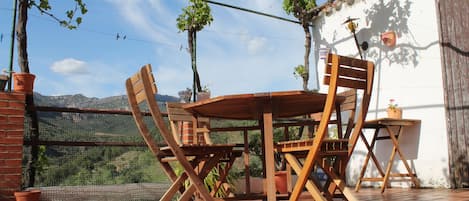
The house features an entrance, a foyer, four double bedrooms, two full bathrooms, a kitchen, a dining room, a laundry room, and a terrace.
The town, with a population of no more than a hundred, offers us the chance to enjoy a few days of relaxation and tranquility.
The entire region is renowned for its wines of the highest quality, and fortunately, La Morera is part of the Priorat Qualified Designation of Origin (DOCa).
The Priorat DOCa comprises nine municipalities, covering an area of more than 17,000 hectares, of which 1,887 are planted with vines and cultivated by more than 600 winemakers.
The best way to discover these great wines is to take a tour of their wineries. They’ll show you the entire production process, the characteristics of the terroir, and the different varieties of their wines, which you can taste at the end of the tour.
That said—and without downplaying its importance—we can also enjoy one of the region’s greatest tourist attractions, as we are located at the foot of the Sierra de Montsant Natural Park.
It covers an area comprising the municipalities of Morera de Montsant, Ulldemolins, Margalef, Cabacés, Cornudella de Montsant, Vilella Alta, Vilella Baixa, Bisbal de Falset, and La Figuera.
The main characteristic of this limestone massif is its steep, rounded shape, which creates a landscape full of caves, chasms, and ravines. To the north of the mountains, the Montsant River flows until it reaches the Margalef Reservoir.
In addition, we highlight the numerous hermitages scattered throughout the area, the rich diversity of flora and fauna—including endemic species—as well as the endless activities available, such as hiking, rock climbing, caving, and mountain biking trails.
The natural park’s office and headquarters are located in the highest part of the town, where staff will provide all the necessary information about Montsant and its surroundings.
This will be the starting point for excursions that will take us to the highest part of the mountain range, along trails such as the Grau de la Grallera, the Espinos, the Agnet, dels Barrots, or Carrasclet, From there, we can visit such beautiful spots as El Toll de l’Ou, La Roca Corbatera, El Clot de Cirer, or La Cova Santa.
For the more adventurous, don’t miss the chance to tackle the Via Ferrata route, which includes a section across a Tibetan bridge.
It’s also worth noting that the GR-171 hiking trail runs through the area.
Heading southwest on TV-7021, just five kilometres away lies the hamlet of Escaladei, a village that grew up next to the ancient monastery of La Cartuja de Scala-Dei, which you can visit. It was founded in the 12th century and is notable for being the first of its kind built on the Iberian Peninsula.
Eight kilometres from La Morera, heading in the opposite direction on the same TV-7021, we arrive at Cornudella de Montsant, the second-largest town in the region, where we’ll find all the services and shops we might need.
After passing through the town and heading north on the C-242, there’s a turnoff that leads to the Siurana Reservoir. During the summer, you can enjoy water sports and swim in its calm waters.
From the same dam, we can take a very pleasant and easy hike. Simply follow a trail that circles the entire marsh until it reaches its end, where we’ll find a natural pool known as the Peaje de la Palla.
In the same reservoir, we can see a massive limestone rock towering over the town that gives the marsh its name, Siurana. Picturesque and considered one of the most beautiful in the entire province, it has been designated a Cultural Asset of National Interest in the “Historic Complex” category.
A few metres away, continuing north along the detour that leads to the marsh, we take a road that becomes winding and steep, leading us to the end of the route, where the town of Siurana is located.
During the