BUONRIPOSO,
is a private residence featuring many double rooms, all with private bathrooms.
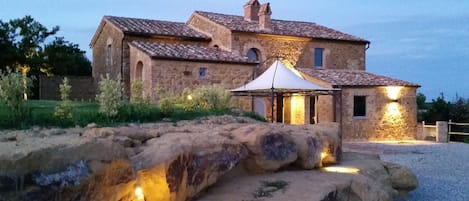
It boasts large living rooms and spacious outdoor porches perfect for summer evenings.
Staying at the Dimora is like staying in a home you’ve always known. Buonriposo has always welcomed people from all over the world: travelers, pilgrims, professionals, and tourists.
Everyone will find a warm and attentive welcome; everyone can enjoy this place to the fullest in every season of the year, and we’ll provide them with all the suggestions on “What to Do”: food and wine tours, spa tours, spiritual tours, hiking tours (on foot, horseback, or mountain bike), sports tours, and cultural tours.
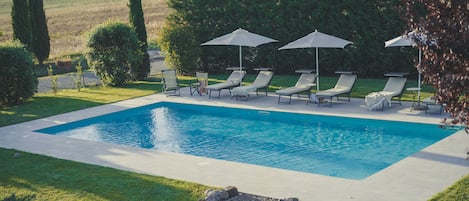
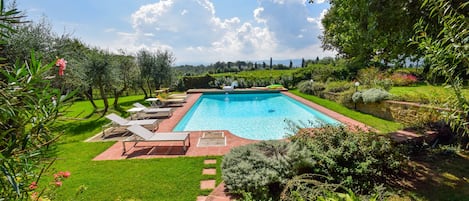
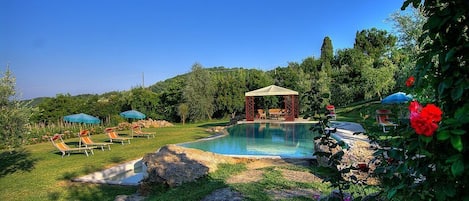
The house features a vast garden overlooking the endless Val d’Orcia, which includes 1 natural saltwater swimming pool, 1 8-person hot tub, one pool bar that’s always open, swings, hammocks, sun loungers, tables for dining, shaded seating for reading, and communal tables for aperitifs at sunset...
For us, every guest represents an exchange of ideas, opinions, culture, shared well-being, and above all, smiles that foster friendships.
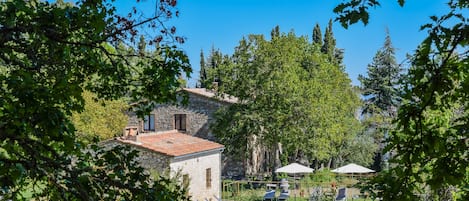
We are located in one of the most enchanting corners of the Val d’Orcia; it has remained unchanged since 1560, the year it was built as a convent and resting place for travelers on the Via Francigena; and yet it is as changeable as its seasons and skies, which turn glassy in the northern winter and take on the hazy hues of a mirage in the scorching heat of August. It has changed with the passing of years and centuries—once a post station, it speaks of alms and taxes; now a protagonist, now merely a scenic backdrop; now once again a farm owned by the Marquises Origo, who played such a significant role in the most humanly luminous chapters of 20th-century Val d’Orcia history. At the Buonriposo estate, everything seems newly born and yet ancient. Time flows, yet does not pass, in harmony with the natural cycle, leading you beyond, to something else, changing your ways, stirring new emotions. At Buonriposo, sit down and listen to the murmur of the wind among the cypresses and olive trees, the ringing counterpoint of the waters of the Orcia, the slow yet incessant clatter, punctuated by the pilgrim’s chanting: these are the carts that traverse the Francigena and go beyond Radicofani, beyond the horizon, circling Mount Amiata.
You, modern-day pilgrims of tourism, at Buonriposo retrace the same paths, feel the same yearnings, and are still amazed by the world around you, with the illusion of time that flows but never passes. Living in this place is not simply staying here, but belonging to the people of the Orcia, where there is a sort of ethical sense of aesthetics. Here, farming means honoring the essence of nature. I cannot explain it any other way: the farmer of the Orcia cannot conceive of a vegetable garden except as a garden, and likewise a vineyard or a field. Il Buonriposo is a testament to how sustainable and compatible tourism—as we understand it—can be achieved: harmonizing human behavior with the principle of leaving a legacy for future generations and properly benefiting from natural resources without them being compromised by human activity. The estate’s garden is dotted with shrubbery featuring the tenacious fragrant broom, blackthorn, dog rose, butcher’s broom, juniper, arbutus, viburnum, and—reigning supreme—the “Roberella,” the mother oak, symbol of this place. Buonriposo is a tapestry of landscapes: the Orcia River, the valley’s lifeline; Mount Amiata, which shelters it; the forest that colors it; the rolling farmland; and the badlands and white rock formations that set it apart.
That’s why Buonriposo is so captivating: it stirs a longing within you that compels you to return, to revisit these landscapes that are truly one of a kind.