We recommend a boat trip to the car-free island of Hiddensee. Ferries to and from Hiddensee depart from and arrive at the ports of Dranske and Wiek.
On Rügen itself, be sure not to miss a visit to Germany’s northernmost point, Cape Arkona. With its 45-meter cliff rising steeply into the Baltic Sea, as well as two lighthouses and the remains of a Slavic temple settlement—the Jaromarsburg—the cape is one of the island’s most impressive destinations.
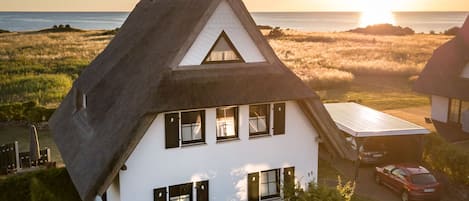
After a coastal hike from the cape heading south, along the ramparts of Jaromarsburg, you’ll come across the small, picturesque fishing village of Vitt, which dates back to the 10th century. Nearby, you’ll find Putgarten, another former fishing and farming village and, at the same time, Rügen’s northernmost municipality. Its thatched-roof houses have a charm all their own. Here, in addition to cafés in the former estate, the Rügenhof, you’ll find culinary highlights and various arts-and-crafts exhibitions.
The famous chalk cliffs near Stubbenkammer are always worth a visit. They are a landmark of the island and offer numerous hiking opportunities in Jasmund National Park.
The Baltic Sea resorts of Binz, Göhren, and Sellin impress with their beautiful beaches and their elaborately restored houses, built in the resort architecture typical of Rügen. You can explore all three towns very comfortably on the Rügen narrow-gauge railway, known as the “Rasender Roland,” and enjoy the fresh steam in the air.
If the weather isn’t ideal, the SPLASH water park in Sagard—with heated indoor and outdoor pools, a water slide, and various saunas—is always a great option.
Rügen has so much to offer that it’s impossible for us to list everything here. We hope you have a wonderful time discovering all that Rügen has to offer and falling in love with the island.