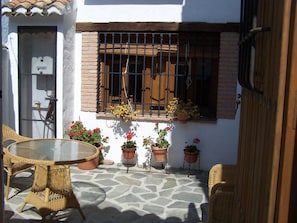
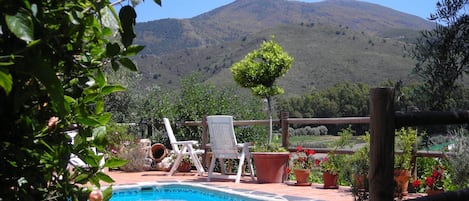
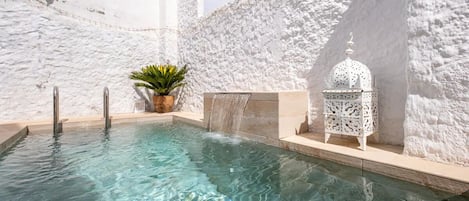
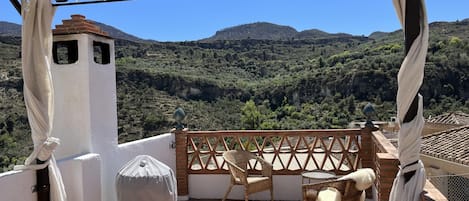
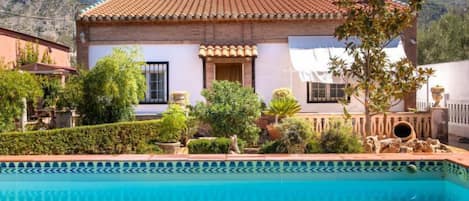
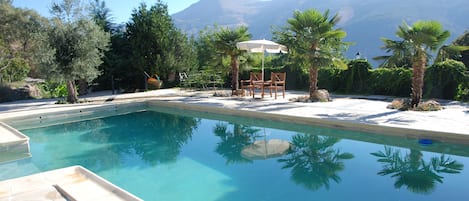
El Corral de Serafín was the result of a dream; everyone was talking about rural tourism in the late ’90s, but no one was taking the plunge. There were two houses set aside for this purpose, but by the time I finished building mine, two more houses and a small hotel had opened, so tourism was starting to take off in the village. I worked in construction, but starting to work on a rural property was a big change. I knew I wanted it to look like a village house, which is why the courtyard of Serafín’s house—that was the owner’s name—became a humble little guesthouse. Unlike the Patio del Carbón, I wanted this house to be very simple: I kept the stone walls, the roofs made of round logs and planks—sloped in the bedrooms and flat on the first floor—the bathroom tiles are hand-painted, and the kitchen tiles are from Fajalauza, a Granada-based company that makes tiles like those found in the Alhambra in Granada. The house faces southeast, so it gets plenty of sun in the winter. Across from the house, you can see María’s vegetable garden and the palm tree that, with great care, she has managed to protect from the weevil that has wiped out all the others in the area. One year, a family from Zaragoza stayed for two weeks; the following year, they wanted to return, but the first week was booked. “Go to the Patio del Carbón,” I told them, “and the second week, move over to the Corral de Serafín”—and that’s exactly what they did. As I was moving things from one house to the other, she said something to me that caught my attention and that perhaps describes this house. She said, “Daniel, the big house is very beautiful, full of details, and very spacious, but when I go into the small one, I feel like I’m coming home.”