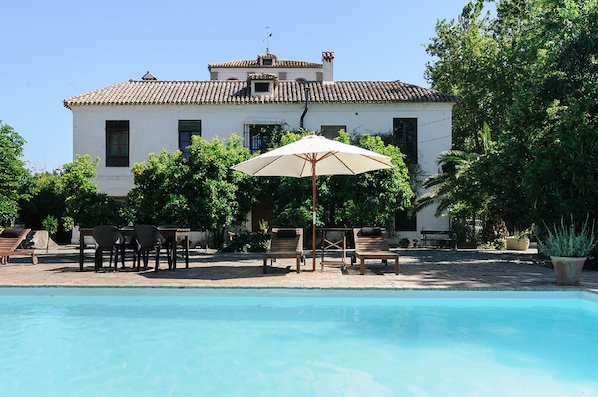
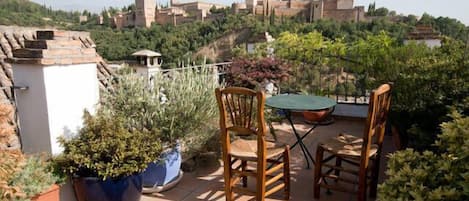
El Cortijo del Pino is a farmstead where various irrigated crops have been grown over the years. In the late 19th century, sugar beets were cultivated there, followed later by hemp and flax. In recent decades, under our family’s stewardship, tobacco cultivation gained prominence in the Vega region and, within a few years, became the primary crop. It was at this time that several drying sheds were added to the building, some of which still remain today.
The main body of the house has a square floor plan. It is structured around a central courtyard with two-story stone columns and a turret housing a dovecote. The second courtyard, or farmyard, lies adjacent to the first and housed the facilities used for farming and livestock: a hayloft, a granary, a dairy, and a pen for animals.
Successive inheritances and the subdivision of the land led to very low profitability, and the disuse of most of the building caused it to deteriorate and made maintenance impossible. Thus, adapting the building for use as rural lodging for tourists was a decisive step toward its preservation. In 1998, we began restoring some of the farmhouse’s most dilapidated rooms, and little by little we have restored most of the structure. Today we have four rural cottages that we offer as accommodations: Los Atrojes, situated around the columned courtyard; La Cuadra and El Tinao, occupying what was once a dairy barn; and El Torreón, which served as a fruit drying room and a dovecote. Throughout the process, we have strived to preserve as many of the existing structural elements as possible and to highlight the building’s architectural value. In 2007, we brought some of the old lands that belonged to Cortijo del Pino back into production and obtained organic certification for them, striving to practice agriculture that is more sustainable and more respectful of our environment and people’s health.