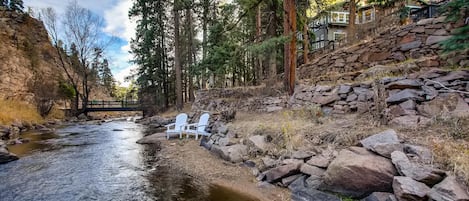
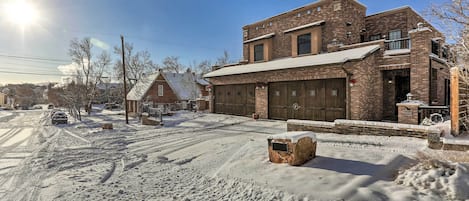
The Golden Guest House is located in the center of Downtown Golden, Colorado. Quality microbreweries, restaurants, coffee, cocktails, live music, parks, trails, climbing, local festivals, and events happening all year long, within walking distance of The Golden Guest House. Golden History Park, and Clear Creek are right across the street. Family friendly, and set up to make your vacation easy—The Golden Guest House aims to impress you.
The MAIN LEVEL includes 2 bedrooms with a Jack-and-Jill style bathroom between them. The south bedroom (bedroom 1) has a new king size mattress, and the north bedroom has a queen (bedroom 2). Both rooms have small desks, and lots of space to store your things. The open living area has two sofas and lots of flexible seating for you to play games, watch movies, or just stare out the window at the stunning Rocky Mountains.
The kitchen is well equipped with everything you’d expect, along with a tea pot, French press, hand mixer, waffle iron, crock pot, roasting pans, baking tins, pasta, grains, hot cocoa, teas, sugar, spice, and everything nice.
Family friendly: A collection of games, and toys will keep young ones entertained. The television is set up for you to connect to Netflix, Amazon movies, spotify, etc. A Pack-n-Play is stored in the king size bedroom closet, with enough clean bedding, and towels for everyone.
The GARDEN LEVEL has a private king suite (bedroom 3) with adjacent flex area (bedroom 4). The large master soaking tub, sink, toilet, and dressing area have lots of space for you to spread out. Also a Jack-and-Jill style bathroom, you can allow guests in bedroom 4 to use the bathroom while still maintaining privacy in both sleeping areas. Laundry, kitchenette / dining area, and separate entrance all on the garden level.
You will have access to the entire front and back yards, charcoal grill, and small front deck looking out over Clear Creek History Park, and Clear Creek beyond.
* Located 10 minutes away from Red Rocks.
*Your host occupies the green addition behind the house. All hosts in Golden are required to be on their premises, but you will likely not see me at all.
*The backyard is open and well lit into the evening. You’re welcome to unplug the lights if you prefer. Feel free to meander up to the rooftop deck anytime for a peaceful look at the stars, or a private yoga session, or just to watch the town go by. Here is some history on the city of Golden:
Golden, Colorado – A Living History
Before “Golden”: Indigenous Roots
Long before any town existed, the Clear Creek valley and the foothills around today’s Golden were home to Indigenous peoples, including bands of Arapaho, Cheyenne, and Ute. These lands were seasonal hunting and travel routes, with access to water, bison, deer, and trade corridors through the Front Range.
The discovery of gold in the mid-1800s disrupted these long-standing patterns of life and led to forced displacement through treaties and military action.
1859–1860s: Gold Rush and the Birth of a Town
Golden was founded during the Pikes Peak Gold Rush of 1859. Prospectors moving west discovered placer gold in Clear Creek, just upstream from where Golden now sits. The area became a natural supply and staging point for miners heading deeper into the Rockies.
Golden City (as it was first called) was established in 1859 by settlers including A. J. Smith, who named it after Tom Golden, a prospector and guide. The town grew quickly as a commercial hub providing food, tools, lodging, and transportation for mining camps in the mountains.
Golden benefited from:
• Its location at the mouth of Clear Creek Canyon
• Access to water power
• Proximity to mining districts in Central City, Black Hawk, and Idaho Springs
By the early 1860s, Golden had become one of the most important towns in the Colorado Territory.
1862–1867: Capital of Colorado Territory
From 1862 to 1867, Golden served as the capital of the Colorado Territory, beating out Denver for several years due to political maneuvering, transportation access at the time, and regional influence.
Key developments during this period:
• Territorial government buildings
• Early newspapers and printing presses
• Schools and churches
• Mills and breweries
Golden briefly envisioned itself as the future political and cultural heart of the territory. However, Denver’s rapid growth, railroad access, and economic pull soon overshadowed Golden. The territorial capital was permanently moved to Denver in 1867, a loss that shaped Golden’s identity for decades.
Railroads, Industry, and Survival After Losing the Capital
After losing the capital, Golden pivoted hard toward industry and manufacturing.
Major institutions and industries shaped Golden’s future:
Colorado School of Mines (Founded 1874)
The founding of the Colorado School of Mines anchored Golden as a center for engineering, geology, and mining sciences. The school brought:
• Stable employment
• A steady population of students and faculty
• Research and technical expertise
This single institution has arguably shaped Golden’s identity more than any other.
Coors Brewery (Founded 1873)
Adolph Coors founded the Golden Brewery in 1873. The brewery grew into one of the largest and most influential employers in the region and became inseparable from Golden’s identity.
Coors shaped:
• Employment patterns
• Local philanthropy
• The town’s economic stability
• Golden’s national reputation
For much of the 20th century, Coors dominated Golden’s industrial life, with generations of families working at the brewery.
Clay, Brick, and Cement
Golden also developed industries tied to local geology:
• Clay mines
• Brick manufacturing
• Cement production
These industries took advantage of the natural resources in the foothills and Clear Creek corridor.
Late 1800s–Early 1900s: A Working Town
Golden became a working-class industrial town with:
• Brewery workers
• Miners
• Railroad workers
• Brick and cement laborers
• Faculty and students from Mines
It was not a glamorous frontier city like Denver. Golden’s character formed around practicality, resilience, and local networks of families who stayed for generations.
Neighborhoods grew near:
• The brewery
• Industrial sites
• The school
• The rail corridor
Downtown developed as a compact main street with saloons, shops, hotels, and services for travelers heading into the mountains.
⸻
Prohibition and the Coors Exception
During Prohibition (1920–1933), many breweries failed. Coors survived by pivoting to:
• Malted milk
• Ceramic products
• Industrial alcohol
• Porcelain and insulation materials
This kept Golden economically afloat while many other brewery towns collapsed. After Prohibition ended, Coors rapidly expanded and reestablished itself as a major beer producer.
Mid-20th Century: Small Town in the Shadow of Denver
As Denver expanded after World War II, Golden became part of the metro orbit while retaining a small-town feel. Suburban growth increased across Jefferson County, but Golden resisted large-scale sprawl due to:
• Its geography (canyons, mesas, floodplains)
• The presence of Coors and Mines
• Zoning and open-space preservation
• Community identity tied to landscape
Golden began to market itself as:
• A historic town
• A gateway to the mountains
• An outdoor recreation hub
Clear Creek became a defining feature, with later efforts to restore it as a recreational corridor.
Environmental Reckoning and Urban Renewal
By the late 20th century, Golden faced environmental challenges:
• Industrial pollution
• Creek degradation
• Flooding risks
• Old industrial sites
The city invested heavily in:
• Creek restoration
• Riverwalk development
• Open space and trail systems
• Downtown revitalization
Clear Creek was transformed from a working industrial waterway into a centerpiece of Golden’s identity, with tubing, trails, and parks drawing visitors from across the Front Range.
Late 20th–Early 21st Century: Tourism, Lifestyle, and Identity Shift
Golden gradually shifted from a primarily industrial town into a tourism, recreation, and lifestyle destination.
Key shifts:
• Decline of heavy industry
• Coors modernizing and downsizing its workforce
• Growth of outdoor recreation culture
• Proximity to Denver making Golden desirable for commuters
• Rising property values
Golden leaned into:
• Trails
• Mountain biking
• Climbing
• Creek tubing
• Festivals and farmers markets
• Historic downtown branding
This transformation brought economic vitality but also tension around:
• Housing affordability
• Short-term rentals
• Traffic
• Balancing tourism with livability
• Preserving small-town character amid growth
Golden Today: A Town Balancing Forces
Modern Golden sits at the intersection of:
• Historic identity (mining town, territorial capital, brewery town)
• Academic identity (Colorado School of Mines)
• Outdoor recreation culture
• Metro Denver pressure
• Tourism economy
Golden’s character today is shaped by ongoing tensions:
• Locals vs. visitors
• Preservation vs. development
• Access vs. protection of natural spaces
• Affordability vs. desirability
The town remains physically small but culturally oversized - a place where frontier history, industrial legacy, scientific education, and outdoor lifestyle collide in a few square miles.
Why Golden Feels Different
Golden never fully became a suburb or a city. It stayed a town with gravity.
It lost the capital and built a different kind of identity - anchored in:
• Place
• Landscape
• Work
• Institutions that stayed put
Golden is less about reinvention and more about adaptation. The creek, the school, the brewery, and the foothills shaped it. Everything else followed.
Occupancy of the unit is limited to four adults and their dependents, if any.
STR-22-0015