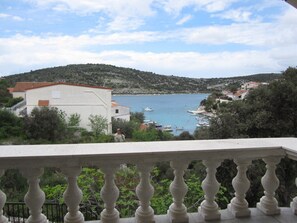
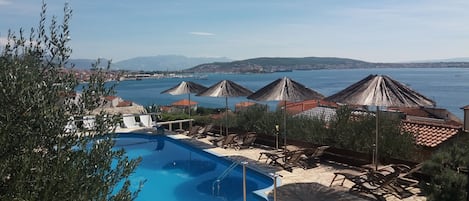
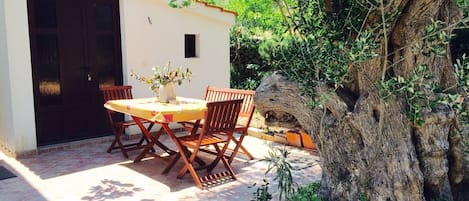
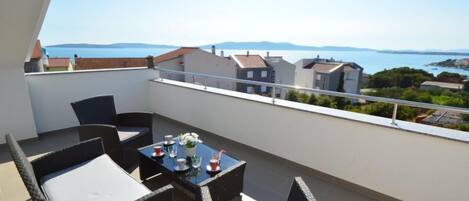
Several small, turquoise-blue coves with crystal-clear seawater surround the beautiful, romantic fishing village of Sevid. Our house is located in one of these coves. Since the Dalmatian capital of Split is about 50 km away and the nearest coastal highway is 8 km away, you’ll find a very peaceful holiday spot with numerous opportunities for excursions and activities. The house has a living area of 65 square metres, plus a 30-square-meter southwest-facing terrace. The unit consists of two double bedrooms, a bathroom, and a large kitchen-living room. It’s only 50 metres to the sea. The beach is partly rocky and partly pebbly, with landscaped, concrete sunbathing areas. Boaters among you will also find a sheltered cove with a mooring. At the small, hidden barbecue restaurant on the beach, you can enjoy the sunset while savouring Dalmatian specialities such as freshly caught fish and a glass of house wine.
Split: The Dalmatian capital is located about 50 km from your holiday destination. Split is the second-largest city in Croatia and was designated an UNESCO World Heritage Site in 1979. Split is, after Zagreb, the second-largest city in Croatia and the economic, cultural, and tourist hub of Dalmatia. Situated on a peninsula in the Adriatic Sea, it is dominated by the harbour bay, which faces southwest, and the Roman-era Diocletian’s Palace, whose layout is still clearly visible in the cityscape today. The western boundary is marked by Marjan Hill, a natural area covered with pine forests and broom. The city’s history begins with the construction of Diocletian’s Palace. Completed in 305 as an imperial retirement residence and later serving as a refuge for the displaced population following the fall of the Roman Empire, the palace—built in the tradition of the Roman castrum—underwent a transformation into an early medieval town.
Trogir: Driving south from Šibenik on the Adriatic Highway, you’ll reach the city of Trogir after about 80 km. The Old Town, with its many narrow alleys, is situated on an island. This island lies between the mainland and another, much larger island called Čiovo. In this city, which is over 2,000 years old, a close juxtaposition of churches, palaces, and townhouses—along with Gothic and Romanesque windows, narrow alleys and airy courtyards, arched gateways, and limestone staircases—creates a Mediterranean atmosphere. Numerous small shops, street cafés, and restaurants housed in historic buildings add to the charm.
The islands of Brac, Hvar, and Vis: The island of Brac is located in the Mediterranean Sea off the coast of Split. Car ferries and hydrofoils coming from Split dock in Supetar, just 8 km away, making this small town the island’s main tourist hub. The island is hilly, sloping down towards the south coast, and boasts countless swimming coves with crystal-clear water. By the way: The stones used to build the White House in Washington came from the quarry near Pucisca. The island of Hvar lies south of the island of Brac and is Croatia’s longest island. Known as the sunniest island in the Adriatic, it is also referred to as the “Madeira” of Croatian tourism. The island of Vis is famous for its wines, olive oil, and many varieties of fish and crustaceans. You simply can’t miss a trip to the neighbouring small island of Biševo: the “Blue Grotto,” with two entrances—one above and one below sea level—makes this cave comparable only to the “Grotta Azzurra” on the island of Capri.